 Tokyo, capital of Japan, is a destination to visit at least once in a lifetime, a city of contrasts, where its modern soul contrasts with its traditional one. Unfortunately, it won't be possible to see everything in a weekend, you'll have to make some sacrifices, but without neglecting great classics such as the Senso-Ji temple, the Meiji Shrine or the Imperial Palace.
As you plan your journey, it’s essential to ensure you have the perfect place to stay. Here are some top-rated 5-star hotels in Tokyo at http://www.tokyo-hotels-stay.com/en/5-stars/ that will offer you supreme comfort and luxury to rejuvenate you after a day of sightseeing. If you're seeking the perfect blend of unparalleled luxury and convenience, consider booking your stay at the Tokyo Four Seasons Hotel. It's located in the heart of the city, providing easy access to major attractions.
Tokyo, capital of Japan, is a destination to visit at least once in a lifetime, a city of contrasts, where its modern soul contrasts with its traditional one. Unfortunately, it won't be possible to see everything in a weekend, you'll have to make some sacrifices, but without neglecting great classics such as the Senso-Ji temple, the Meiji Shrine or the Imperial Palace.
As you plan your journey, it’s essential to ensure you have the perfect place to stay. Here are some top-rated 5-star hotels in Tokyo at http://www.tokyo-hotels-stay.com/en/5-stars/ that will offer you supreme comfort and luxury to rejuvenate you after a day of sightseeing. If you're seeking the perfect blend of unparalleled luxury and convenience, consider booking your stay at the Tokyo Four Seasons Hotel. It's located in the heart of the city, providing easy access to major attractions.
Here are all our tips on how to organize a Tokyo itinerary in 3 days!
Consider buying a card: to save on the cost of individual attractions or transport, we recommend buying a Tokyo Pass for the metro. Prices from €7.43.
Day 1
Distance traveled: 6.5 km
Places visited: Asakusa district and Senso-Ji Temple (free), Sumina district and Tokyo Skytree (entrance fee €13.92), Ueno Park, Akihabara district
Where to eat: Lunch at Moomin House Cafe, Dinner at Tanaka Ramen(Get directions)
First time in Tokyo? Let us guide you: for a first approach to the city, we recommend a Hop-on Hop-off sightseeing bus tour, to identify landmarks and learn stories and anecdotes.
1 - Asakusa District and Senso-Ji Temple
 An itinerary in Tokyo can only begin in the Asakusa district, the city's historic district. It is located about 4 km from Tokyo Central Station and can be reached by the Ginza Line train from Nihombashi Station to Asakusa Station.
Enjoy part of the morning in this wonderful place, which will take you back in time to when the city was still called Edo. The district's main attraction is the Senso-ji Temple, the oldest temple in Tokyo and the most important Buddhist temple (daily 6am-5pm, free admission). Enjoy a stroll along Nakamise Dori, a street full of typical shops, ideal for buying some souvenirs!
If you'retravelling with children: in this case, consider a visit to Asakusa Hanayashiki, a small amusement park located just behind the temple, with roller coasters, rides and lots of activities. Get directions
2 - Sumina District and Tokyo Skytree
 In the late morning, head to the nearby Sumida district, a residential district east of Asakusa. You can also walk from the temple to Sumida Park, a beautiful riverside park (210 m, 3 min).
From the park it's only a 15 min walk to the Tokyo Sky Tree, Japan's tallest building (daily 8am-10pm; entrance 2,100 yen/€16.00). At 634 m, it is also currently the second tallest structure in the world, after the Burj Khalifa in Dubai. Take the Tembo Shuttle, the fastest panoramic lift in Japan, and reach the observatory on Floor 350, 340 m above sea level. The view from up here is truly incredible!
SEE ALSO: Visit the Tokyo Sky Tree: times, prices and tips
Buy yourticket online: this is one of Tokyo's most popular attractions. We recommend buying your ticket in advance to skip the queue at the ticket offices.
3 - Tokyo National Museum and Ueno Park
 In the early afternoon, head to Ueno Park, Tokyo's green lung. From Tokyo Skytree take the Asakusa Line underground from Oshiage Station (Skytree) to Asakusa Station (3 min), here change to the Ginza Line to Ueno Station (5 min).
Enjoy a walk in the beautiful Ueno Park, one of the most beautiful parks in the city. Here you can stroll through the park's paths, rent a boat on the lake and look for the various statues scattered around every corner. During spring, it is one of the best places to admire the cherry blossom trees, one of the most beautiful phenomena in Japan.
Option B to the Tokyo National Museum. This museum offers the richest collection of Japanese art in the world (daily 9.30am-5pm; full admission 1,000 yen/€7.80, concessions 500 yen/€3.90). In this case, the visit lasts an average of 2 hours. It is located inside Ueno Park.
SEE ALSO: What to see at the Tokyo National Museum: opening hours, prices and tips
Alternatives to the National Museum: If you are travelling with children, inside Ueno Park you will also find the Ueno Zoo, with over 400 animal species, including pandas (600 yen/€4.60), or the National Museum of Nature and Science (630 yen/€4.90).
4 - Akihabara district
 By mid-afternoon, head to the nearby Akihabara district, one of Tokyo's most distinctive. From Ueno Park, take the Hibiya Line from Ueno Station and get off at Akihabara Station (3 min).
Tokyo is an eclectic and cosmopolitan city and the best way to discover each of its facets is to explore its particular neighbourhoods. Akihabara, for example, is the district of electronics and otaku. Here you can find shops open around the clock selling anime, manga and related products, as well as electronics and video games. Moreover, at night it is completely illuminated by neon signs and lights, a unique sight. Here you will also find Maid Cafés, where you will find butlers or waitresses in typical 19th century uniforms, or Neko Cafés, or Cat Cafés, where you can cuddle cats.
Astop-off for anime lovers: don't miss Animate Akihabara, a huge shop selling everything from T-shirts to comics to limited edition gadgets! A true temple for collectors. Get directions
Day 2
Distance travelled: 11.9 km
Places to visit: Tsukiji Fish Market, Tokyo Imperial Palace (free exterior), Shibuya district and Meiji Shrine (gardens 500 yen/€3.90), Harajuku district, Shinjuku district and Golden Gai
Where to eat: Lunch at Yoshinoya, Dinner at Ramen Nagi - Shinjuku Golden-gai Honkan(Get directions)
1 - Tsukiji Fish Market
 '/>"/> Start this second day at Tsukiji Fish Market, the largest fish market in the world! Again, the market is easily accessible from Tokyo Central Station: metro Marunouchi Line to Ginza Station (3 min), then change to Hibiya Line to Tsukiji Station (3 min). Alternatively, walk about 30 min.
This place is world famous for the tuna auction. Mornings are when it is busiest, but when you can immerse yourself in the everyday life of the city's inhabitants! One section is dedicated to wholesalers, while inside is an area where the fish is processed and sold at retail. Numerous sushi restaurants can also be found here.
Admire Tsukiji Hongan-ji from the outside: not far from the market is this marvellous 17th century Buddhist temple with its unusual architecture, in contrast to the other temples in the city. Take a souvenir photo in front of it. Get directions
2 - Tokyo Imperial Palace
 After strolling through the stalls of the fish market, head to the main official residence of the Japanese Emperor: the Tokyo Imperial Palace. The most convenient option is to take the Hibiya Line from Tsukiji Station to Hibiya Station (4 min), then walk across the Iwaida Bridge to the palace gardens.
Actually, the Imperial Palace, housing the Emperor's family, is not open to the public. However, you can visit the Palace's beautiful East Gardens, or East Gardens, which are built around the ruins of the ancient Edo Castle. Alternatively, you can join a free guided tour held twice a day (10 a.m. and 1.30 p.m., duration 75 min), during which you visit the East Gardens and also some of the gardens inside the Palace walls.
SEE ALSO: Visiting the Imperial Palace: how to get there, prices and tips
Not to be missed in spring: the garden is full of beautiful cherry trees, which blossom in springtime, providing a unique spectacle. Hire a boat and take a tour of the palace moat for a wonderful view of the city and gardens.
3 - Shibuya District and Meiji Shrine
In the late morning, head to the Shubuya district, the district of young people and new trends. From the Imperial Palace, the most convenient option is to take the Hanzomon Line metro from Otemachi Station and get off directly at Shibuya Station.
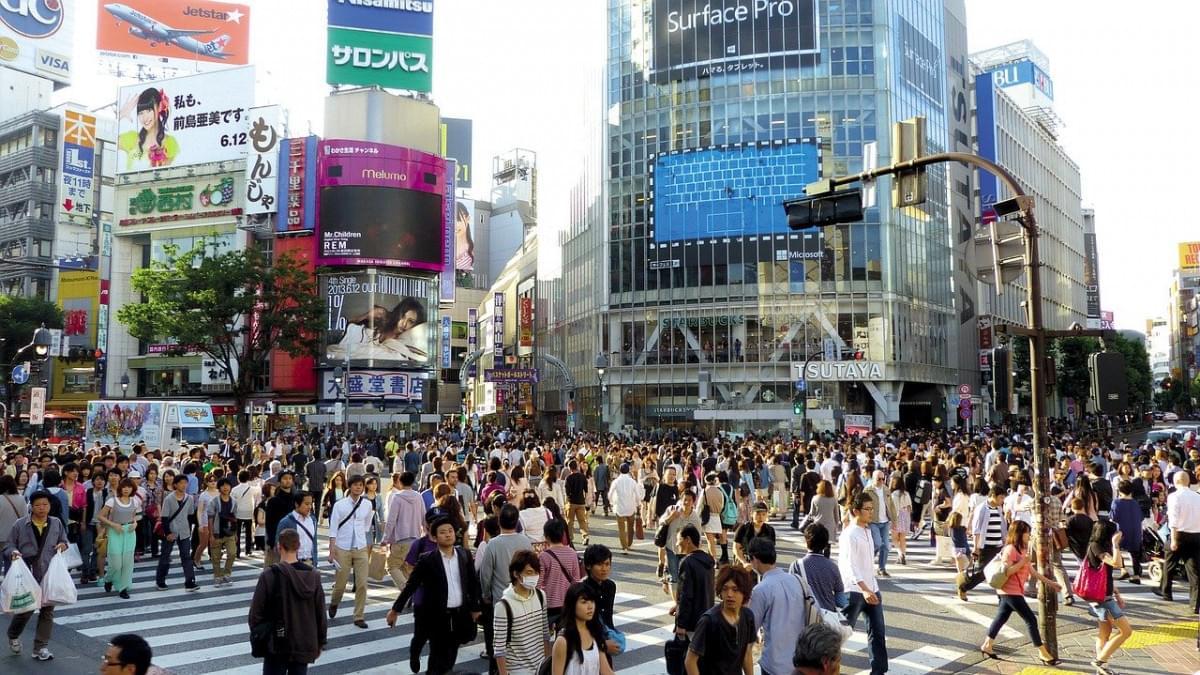
Here you will find one of the symbols of Tokyo and Japan: the world's busiest intersection. Have lunch at one of the many restaurants or street food stalls, enjoy a stroll through the shops or stop at one of the many quirky themed cafés!
For the first part of the afternoon, we recommend two alternatives:
Option A at Meiji Shrine, one of Tokyo's most symbolic holy sites (open until sunset; free admission). This shrine venerates Emperor Meiji and Empress Shoken. Enjoy a stroll through the park's gardens, its buildings and the silence it offers. For a moment it will almost seem as if you are far from the city;
Option B at Yoyogi-kōen, one of Tokyo's most beautiful parks, a must-see during spring. But having visited Ueno Park on the first day, you may be more interested in visiting the shrine.
Takea photo with Hachiko: you will find the statue outside Shibuya station. Surely one of the most famous dogs in the world, whose story of loyalty, also told in the 2009 film starring Richard Gere, brought a tear to everyone's eye! Get directions
4 - Harajuku District
 After visiting Meji Shrine, head down the hill where it is located and you will immediately find yourself immersed in the Harajuku district, another of Tokyo's must-see neighbourhoods, which is built around the station of the same name.
Harajuku is the district of youth culture and new trends. Enjoy a stroll along Takeshita Dori, the long avenue full of shops of all kinds, both oriental and western, such as the big brands of the fashion world. You will certainly have the chance to meet many cosplayers, i.e. people who dress up as characters from video games, anime and manga!
Discover pop kawaii: 'kawaii' in Japanese is a term meaning 'cute' and 'adorable'. This culture of the beautiful and the "cute" extends to everything from clothing to food and even entertainment, offering objects and clothes with an almost childlike style, just think of the very famous Hello Kitty.
5 - Shinjuku and Golden Gai district
 Finally, for the evening, head to one of Tokyo's iconic neighbourhoods, the Shinjuku district. From Harajuku Station hop on the Yamanote Line metro and get off directly at Shinjuku Station (5 min).
Shinjuku is the most representative district of modern Tokyo, it could be compared to Times Square in New York. It represents the area that never sleeps, characterised by huge neon lights and screens on all night and numerous clubs of all kinds. It is, in fact, one of Tokyo's nightlife districts!
Less than a 10-minute walk from Shinjuku station, you will also find the Golden Gai, a small area characterised by alleyways with lots of small bars with a maximum of 10 customers each. Here you can discover the most traditional nightlife and you can also taste yakitori, small meat skewers typical of the area.
What to know about Golden Gai: this is a very friendly area where you can meet a lot of people. But beware, some places do not welcome foreign tourists! If you find such a sign at the entrance, do not enter and move on to the next place.
Day 3
Distance travelled: 16 km
Places visited: Ginza district, Odaiba district and Borderless teamLab (3,200 yen/€24.80), Azabu Juban district, Roppongi Hills district
Where to eat: Lunch at Yuki, Dinner at Ginza Kagari (Roppongi Hills)(Get directions)
1 - Ginza District
 Last day in Tokyo, start it off by exploring the Ginza district, the city's classy and elegant neighbourhood. Here, taking Tokyo Central Station as your reference point, you can reach it comfortably on foot (15 min).
The Ginza district is characterised by the presence of expensive restaurants and high-fashion shops, such as Chanel and Dior, to name but two. Enjoy a stroll among the large shop windows and, if you visit this area at the weekend, the main street is also closed to traffic, making it a pedestrian zone.
3D latte art at Ken's Coffee Shop: Tokyo is the city of unusual things and, at this café, you can order a 3D latte art, a kind of cappuccino where a 3D shape is recreated with foam. You can decide what you want in your cappuccino, the most popular being the cat. Get directions
2 - Odaiba District and TeamLab Borderless
 In the second part of the morning, head to the Odaiba district, an innovative neighbourhood built on an artificial island. From Ginza, the best option is to walk to Shimbashi Station (less than 10 min) and here take the Yurikamome Line metro and get off directly at Aomi Station (20 min).
Odaiba is an innovative district with shopping malls, interactive museums and a beautiful view of the Tokyo skyline. Outside one of the shopping malls, you can also find the life-size Gundam statue, which is more than 20 metres high and at certain times of the day transforms under the stunned eyes of tourists.
Here we also recommend a visit to the Borderless teamLab, a spectacular interactive museum that is becoming increasingly popular and popular with tourists (Mon-Fri 10am-5pm, Sat-Sun 9am-7pm; internal entrance 3,200 yen/€24.80, concessions 1,000 yen/€7.80). You can find yourself walking through a hall of mirrors, admiring the beauty of thousands of floating lanterns and taking very Instagrammable photos.
Enjoy the view from Shiokaze Park: the best spot from which to admire the Tokyo skyline and, above all, the Rainbow Bridge, the city's most famous bridge. Get directions
3 - Azabu Juban District
 Next, head to the Azabu Juban district, an upmarket residential area of Tokyo with plenty of shops and clubs, especially Western-style. From the Odaiba district, go to Odaiba-Kaihinkōen Station and get on the Yurikamome Line underground to Shiodome Station (12 min), here take the Oedo Line and get off at Akabanebashi Station (6 min).
Enjoy a stroll through its streets before arriving at the last stop of the day. Did you know that this is the birthplace of Sailor Moon? Many episodes were filmed here, so if you're a fan, you can't miss it.
Option B at Tokyo Tower, one of the symbols of Tokyo (daily 9am-11pm; observatory at 150 m 900 yen/€7.20, observatory at 250 m 2,800 yen/€22.50, entrance ticket here). If you like to admire cities from above, besides the Tokyo SkyTree you must also visit this particular tower. It has two viewing terraces, one at 150m and one at 250m, from which you can enjoy a wonderful 360° panoramic view of the city! Inside it is also home to FootTown, a 4-storey shop and all around numerous shops and clubs, ideal for spending a few hours.
Buy your ticket online: like the Skytree, Tokyo Tower is one of the city's most popular attractions. Buy in advance to avoid wasting time at the ticket office.
4 - Roppongi Hills district
 Finally, spend the last evening in the Roppongi Hills neighbourhood, Tokyo's international district. From Azabu Juban, you can easily walk there in about ten minutes.
Roppongi is home to numerous buildings housing international embassies, as well as numerous restaurants, bars, clubs and discos frequented especially by expats. In fact, this district is one of the hubs of Tokyo's nightlife. But before you descend into your last night in the city, we recommend admiring the panorama and the illuminated city from the observatory of the Roppongi Hills tower, the Tokyo City View, open until 10pm (from 1,800 yen/€14.00).
A night out for all tastes: this district is home to some of Tokyo's most famous nightclubs, such as V2 TOKYO, an exclusive and very popular club, or Pasela Roppongi, a famous karaoke venue.
Alternative for day 3: Tokyo Disneyland
Alternatively, especially if you're travelling as a family, you can spend this last day at Tokyo Disneyland, the city's famous Disney amusement park (open between 8:30/9:00, close between 18:30/22:00; full-day admission 8,200 yen/€65.00), concessions 6,900 yen/€54.60).
Located southeast of central Tokyo in Urayasu, it is a kind of city within a city. Inside it houses 39 attractions and plenty of activities, including restaurants, shops and relaxation areas. It is divided into 7 thematic areas: World Bazaar, Fantasyland, ToonTow, Tomorrowland, Adventureland, Westernland and Critter Country. The ideal place to become a child again for a day.
How much does a weekend in Tokyo cost
 '/>"/> To visit Tokyo the biggest expense you'll have to face will be the flight (compare flights), but once you're there you can organise a cheap trip. The best areas to stay in are the Chiyoda and Chuo districts, with a great central location. Throughout the city, however, it is possible to find hostels and capsule hotels with very competitive prices.
To get around you will have to use the metro, which is punctual and very efficient. We recommend the purchase of a metro pass, also available for 72 h, ideal for your stay. For lunch and dinner, we recommend street food, which is excellent and above all inexpensive, while in the evenings, stay in traditional places, avoiding those that are too touristy.
Let's look in detail at the costs of a weekend in Tokyo:
Costs for eating: about €40.00 per day per person (including breakfast, lunch, dinner)
Costs for museums and attractions: average price €20.00 per person per day following our suggested itinerary
Transport: average price €10.00 per day per person - buy metro pass
Hotels, accommodation and B&Bs: from €30.00 per room - look hotels at tophotels.com
Entertainment: from €50.00 per day per person (including snacks, coffee, drinks, ...)
Total cost of a weekend in Tokyo: from €360.00 per person (excluding flights and/or transfers)
Before leaving: useful tips
When to visit Tokyo: Tokyo can be visited all year round, but surely the most fascinating period is spring, when the cherry trees are in bloom - find out more here;
Where to stay: the most centrally located districts are Chiyoda and Chuo. For families also Ueno district. For nightlife Shinjuku, Shibuya and Minato. For economy Ueno, Asakusa, Sumida and Arakawa;
Get around by metro: the best way to discover Tokyo. Getting around on foot is unthinkable. To save money on travel, buy the Tokyo Metro Pass;
Be organised: Tokyo is a big city, so don't waste too much time getting around. Plan your itinerary in advance, optimise your movements and buy tickets in advance, such as for the Tokyo Skytree and Tokyo Tower;
Always have the internet with you: moving around and settling in such a big city is complicated. To have the internet with you at all times, including Google Maps, buy the Japan Unlimited Pocket Wi-Fi Router Rental;
Taste the street food: stop at markets, sample Japanese street food and traditional dishes like ramen. For more unusual experiences, visit a Neko Café or Maid Café;
Experience theabsurd: Tokyo is the city of unusual experiences. You can, for example, explore the city in go-karts like Super Mario, meet owls at the owl café in Akihabara or dine in a Robot Restaurant;