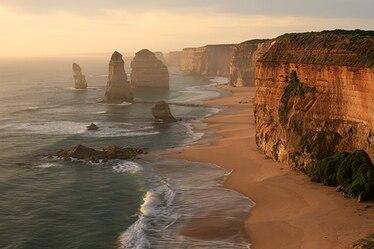
Limestone sea stacks known as the Twelve Apostles (there are actually only eight) represent one of the star attractions along Australia's Great Ocean Road.
Travel
Intelligent Travel
But there’s a bit of yin and yang to travel. Once I’ve had my fill of urban experiences, I start plotting an escape.
I like to find cute little towns that make me dream of a simpler life and get out into the countryside to experience landscapes and wildlife that help me connect with a region’s rural roots.
A big part of Melbourne's appeal is the fact that so much natural beauty lies a mere day-trip away. And what makes it even more amazing is the ease of finding great accommodation close to the city center, like the Hotels in Victoria at hotelsinvictoria.net. These hotels offer comfort and convenience, making them an excellent base for any day trips planned.
I’ve already described the appeal of the Yarra Valley wine wonderland and the little penguin denizens of Phillip Island, both of which are less than a two-hour drive from Melbourne.
Here are three more idyllic ways to spend a day (or a weekend) in Victoria:
>Great Ocean Road
From Melbourne, head southwest for a little over an hourto Torquay to begin your journey along Australia’s famous scenic drive.
The Great Ocean Road, which hugs about 150 miles of the Victorian coast, lives up to its lofty name. While ever present signs tempt you to discovernew beaches and bluffs around every bend, small towns likeApollo BayandLorneoffer typical but nonetheless delightful seasidestandards like ice cream shops and seafood restaurants.
The farthest I got on my journey, drinking in the eucalyptus-scented breeze through open car windows, wasthe Twelve Apostles, a magnificent collectionof craggy limestone rocks rising up from the Southern Ocean.
I posted what ended up being my most popular Instagrams in months, of two of the looming sea stacks surrounded by turquoise water against Victoria’s dramatic coastline.I don’t filter any of my snaps, but this one looked as ifit had been airbrushed and tinted for a magazine cover, no thanks to my photography skills.
Tip:Short helicopter rides over the Twelve Apostles offer a great bird’s-eye view of the coastline, but I found equallydramatic (and cost-efficient) vantage points onthe ground. Wear good walking shoes to follow all the platforms out to the end.
Stay overnight:There’s a lot to see on the Great Ocean Road,especially if you want to make it to the very end of the line at Allansford. Give yourself a chance to discover its gems without inviting exhaustion by planning an overnight stay along the way.
Located at the approximate midpoint of the route, the Great Ocean Ecolodge is a charming, ecologically sustainable five-room resortrun by the Conservation Ecology Centre. After a stay here,you are guaranteed to care about the fateof thetiger quoll, one of the nonprofit organization’sbiggest priorities.
Tiger quolls might not be as cute as eucalyptus-munching koalas (another of the center’s conservation targets), but these carnivorous marsupials face more urgent threats. They also have some of the most powerful jaws in the world. “These guys smash bones like butter,” said Shayne Neal, cofounder of the lodge along with his wife, Lizzie Corke.Plus, every dollar of profit the couple brings in from the lodge is reinvested into wildlife protectionefforts.
> Restaurant Brae
Located 85 miles southwest ofMelbourne, Brae is the creation of Dan Hunter, one of Australia’s most well-regarded chefs.
When it comes to Australian eateries, Brae sits atop many best-of lists. Having beenlucky enough to eat at some of the world’s most celebrated restaurants, I know positivehypedoesn’talways equate to a great dining experience. Many are well-oiled machines without any discernible passion.
Not Brae.
Set amid 30 acres of heritage wheat crops and grazing leas for sheep, this is truly a restaurant worth traveling for, especially for thosein search of unencumbered relaxation in the Victorian countryside.
Stay overnight: The small town of Forrest, 15 miles south of Brae and a short drive from the Great Ocean Road, offers a whollyendearing B&B experience with theForrest Guesthouse.
> Echidna Walkabout
When Iarrived at You Yangs Regional Park, the uniquequality of light and photogenicindigenous gum trees called to mindthe impressionistic paintings of Australia’sHeidelberg School. I had to remind myself that we’re not here simply to admire thescenery.
Janine Duffy andRoger Smith established Echidna Walkabout in 1993out of a shared passion for protecting and celebrating the wildlife that makes its home in the flat volcanic plains between Melbourne and the port city of Geelong.
Operating on the premise that people protect what they know and love, the founders workto instill both asense of awe and familiarity in their guests, whether they are educating about koalas, echidnas (a close relative of the platypus and one of the oldest mammals on Earth), or bull ants.
The ever humble Duffy refers to herself as a citizen scientist, but her penchant for facts, figures, and—best of all—storytelling is impressive, and contagious.
When we got up close to kangaroos, we learned that a baby ‘rooclimbs into itsmother’s pouchafter a gestation period ofapproximately 30 days, when it’s the size of a jelly bean. Duffy explained that research is currently underway to determinewhether enzymes that allowbaby kangaroos to breathe independently at such an underdeveloped stage have the potential to help human premies survive infancy.
Though Duffy cares deeplyabout local wildlife, great and small, one of her biggest passions is koala conservation.
“Scientists are predicting the extinction of koalas in about 30 or 40 years,” shetold usgrimly. And while some populations are thriving, and even overabundant (such as those found along the Great Ocean Road), she quickly noted: “That doesn’t mean we don’t have a problem.”
“We’re still in the stage now where we can save them if we change a few things,” she said. To that end,sheestablishedtheKoala Clancy Foundation(named for a koala she has been monitoringfor years) in 2015 to support the wild koalas of the Western Plains of Victoria, particularly around the You Yangs andBrisbane Rangeswest of Melbourne.
She taught usthat that theboneseed weeds (introduced to Australia from South Africa) are degradingkoala habitat and encouraged us to pull a few ourselves to help stem the tide. Thanks to each Echidna Walkabout tour following suit, she estimates 70,000 of the invasive plants are removed from the landscape annually.
At the end of the day’s excursion,our group sat down to enjoya picnicin the shadeas koalas clung to branches overhead. I felt as if I had made it into the very heart of Australia, but in reality I was a mere45 minutes from Melbourne.