
The title is a quote by and I use it because I’ve spent the last several weeks trying to write this post but failing, especially when it came to the title. What do you title a blog post about Auschwitz-Birkenau?
We had 3 days in Krakow, and on the first day we went to Auschwitz. This was something I wanted to do for a very long time; I started reading about WWII and the Holocaust when I was 10 years old and have never stopped. It’s one of those things that you can’t let go until you finally understand it, and I’ll never completely understand it.
In Poland it is called Oświęcim. The Germans called it Auschwitz when they took over the old Polish Army barracks and first turned it into a concentration camp for Polish political prisoners, and then gradually grew it into an unfathomably huge death camp.
We walked to the bus station in Krakow, and though Rupert usually deals with buying our tickets in foreign countries, I wanted to handle this one. But I couldn’t bring myself to say, “Two coach tickets to Auschwitz, please,” out loud because it sounded so…casual. I whispered/mumbled it, but the ticket-seller couldn’t hear me, and thus I took a deep breath and cleared my throat and even though I knew I was messing it up badly, I said it with something like the proper Polish pronunciation, Oz-veech-yim.
She understood me. We got on the bus at about 10 a.m. and that’s when my stomach started to turn to lead. I’d spent years wanting to make this trip, learning everything I could about one of the most revolting and massively evil things humanity has ever done, and I was nervous when I realized it was finally happening.
But it all looked so normal on that hour-and-a-half ride. I watched for the road signs, and they looked just like road signs in Texas.
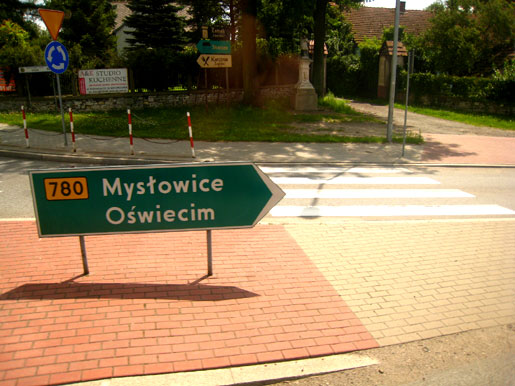
There was a moment on the bus when I realized we were seeing the exact sort of trees and scenery that people would have seen on their way to the camp in the cattle train cars, if they were one of the few near the narrow slits. I felt physically sick to look at the trees.
The first thing that’s surprising about Auschwitz is that it is not as secluded as you expect; it’s just right there in what seems like the middle of an average little town. It’s jarring. There’s a busy parking lot filled with buses and cars and noisy tourists, about 50 yards from the entrance.
Admission to the Auschwitz Museum is free and the museum is actually housed within several of the old barracks. But first you have to pass through the most infamous gate in history:
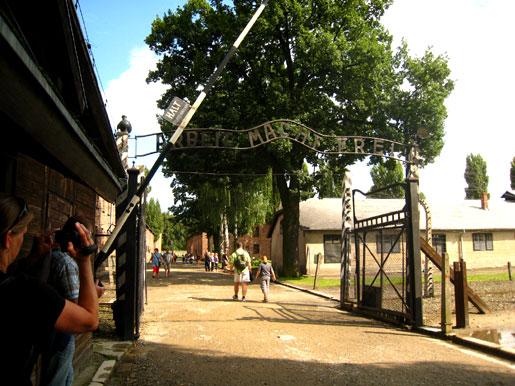
It was the most surreal moment of my life so far. There it was, this object seen in a thousand photographs, attached in my mind to abject despair and massive human suffering…and now it’s surrounded by happy tourists. It was almost like a Disneyland version of hell, with all the pleasant camera-toting tourists. Of which I was one. It was the worst case of cognitive dissonance I think I’ll ever experience.
Also, I was surprised by the small size of that gate because I always imagined it to be a lot larger. But it’s even a little more disturbing than I expected. It looks like something a person might put at the entrance to their garden.
Goddamn Hoess. Do you know the origin of the slogan on the gate, Arbeit Macht Frei? Rudolf Hoess, head of the camp, had himself been in prison during the 1920s, and supposedly remembered that the only thing that had gotten him up in the morning during that time was the knowledge that at least he could work. So, as he said later, he copied that slogan from the gate at another camp to help ease the experience of the prisoners.
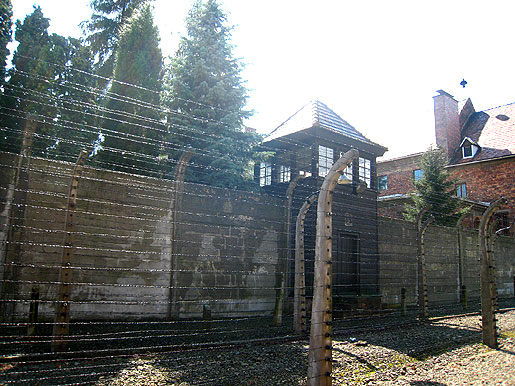
I will tell you right now. The entire day was a series of intensely upsetting moments of terrifying and physically sickening clarity, interspersed with tears, laced with disbelief and all surrounded by a general feeling of impotent but genuine strong rage. We walked towards this guard tower at the end of one of the streets in the camp, and I was overwhelmed with flashes of what it would have looked like to a person in about 1943, a person starving and dehumanized and dying of dysentery and infected wounds. It’s not “interesting” or “spooky” or “creepy”. It’s devastating.
One of the museum displays is in , which was the “medical experimentation” building where animals like Dr. Josef Mengele tortured and killed people, including children. We stood on the gravel street in front of Block 10, and all the things I ever read about or saw in a documentary about the Nazis’ experiments went through my mind, and I simply couldn’t believe I was looking at the place these things happened. It’s just a red brick building, sitting there like any other building.
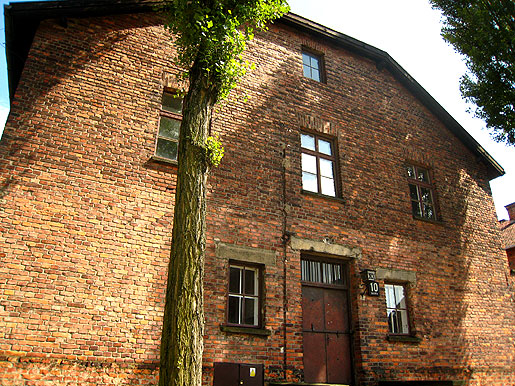
We went in and it made us feel sick, but we both were affected more severely by . That was the “prison” building. It was horrible.
In the basement, you can go into or peek into the “starvation rooms” where they put prisoners and gave them no food until they died. There’s a “suffocation room”, which was sealed and into which the Nazis sometimes put a burning candle to use up the oxygen until the prisoner died.
Worst of all, to me, were the “standing cells.” You can actually go in one of these today but neither of us had any will to do that. There are four of , all in one tiny cave of a dark room at the end of a profoundly depressing corridor. They are 3 x 3 feet in area each, and up to four men would be put in each of these cells at once for days and weeks, only being taken out during the day for slave labor. There wasn’t any ventilation, light, or a way to sit or lie down.
I didn’t take pictures of the standing cells. It was genuinely too disturbing and upsetting to process the information about that space. I felt claustrophobic and panicky, and I was just a tourist.
The courtyard between Blocks 10 and 11 is closed off from the rest of the camp, and is where prisoners were taken from Block 11 to be executed for “crimes” such as stealing a lemon. There was a special wall for this executional purpose, and it is appalling to stand in front of it now. The day we were there, the rain and sunshine were doing battle, and we ended up staring at the execution wall just as the sun came out and the rain stopped.

It was difficult to imagine so many violent and unjustified deaths happening in that spot. The sun on the raindrops on the flowers left behind by visitors made my head swim.
For years, I expected that when I finally went to Auschwitz, I’d sob the entire time. But I didn’t. There was something about it not being about me that made it seem inappropriate to cry. But I was choked up the entire time, with that feeling that the throat is in a vise and the eyes are burning.
But there was one moment when I did lose control and let out a few uncontrollable sobs. That was in Block 5, which houses the “material evidence” taken from the victims of the camp, mostly within a few minutes or hours after arriving on the transport trains, shortly after which they were killed.
You walk into long, wide rooms that held bunks for prisoners, but today the narrow way down the middle is flanked not by bunks but by breathtakingly gigantic glass display cases full of personal things like shoes, eyeglasses, dishes, razors, hairbrushes, and suitcases. There were so many of those suitcases, all with names written on the outside, some of which you can tell were done in a hurry. All the names were Jewish.
Other display cases hold prosthetic limbs, more than you could imagine. There is a pile of eyeglasses that makes your heart break. I didn’t take pictures. There are some .
For some reason it was the shoes that really got me. I’ve read that the shoes on display in that barracks represent less than one day’s “haul” from the new arrivals. I cannot conceive of it. There are thousands and thousands of shoes in that room. Walking through the door was like being punched in the chest, like your breath is sucked out of you. That’s when I finally started crying, I couldn’t help it and I wasn’t the only one. All the other women there were in some stage of tears, and so were half the men.
Those shoes. There were holes in some of the soles; you could see the wear patterns on the heels. Some of them looked just like my own shoes, all the weight on the outer edge. There were pretty girlie sandals and stylish pumps that you could still model today. Worst of all were the children’s shoes. They were so little…
But it got worse. In another room in that same barracks is a whole display case explicitly for all kinds of children’s things. Tiny onesies, infant socks, sleeper jammies, wee little caps and bonnets, toddler-sized shoes and little jackets and frocks. Blankets and strollers. Rattles and feeding bottles. I don’t have children and am not maternal but that display case ripped my heart out completely and I can’t fathom how a parent whose child would fit into those onesies and booties could possibly remain sane while looking at that display.
I think this is something people don’t think about much with the extermination camps, possibly to maintain sanity. The main image we all have of the camps is of the starving inmates at liberation in 1945, the piles of starved bodies – always adults. As fully horrific as that is, we’re rarely reminded that hundreds of thousands of children were brought to these camps were not ever photographed again, such as at liberation, because they were taken (usually with their mothers) straight from the train to the gas chamber. They couldn’t work and would only be a burden, so they were killed almost instantly. But not before the Nazis took everything off of them and shipped it all back to German civilians to keep Frau Housewife happy while Herr Husband was gone to war.
We spent a few hours in this main camp part of Auschwitz and went into most of the barracks that have displays, and into the bunker that had the early “inefficient” gas chamber and crematorium. I’ve read that they had to stop gassing people in there because the screams were so loud that even the two motorcycles they had just outside, revving up as much as possible, were not enough to drown out the screams, which disturbed the other inmates.
This is part of the reason that Birkenau was built about 2 miles from the main camp. was originally intended to be a POW camp for Soviet prisoners; Himmler ordered it be built in early 1941 and he wanted it to house at least 100,000 men. So it had to be big.
Soviet POWs were made to built the camp themselves, and most of them died. Only later did the Nazis decide to fill up the place with slave laborers who were mostly Jews, and to use the far corners of the camp for mass genocide of the rest of the Jews they brought in, along with Gypsies, homosexuals, and priests.
A five-minute shuttle ride took us from the main Auschwitz camp to Birkenau. We came around a bend and could see the infamous main entrance, and everything I ever thought I knew about Birkenau fell out of my mind like broken glass. It was not the main entrance that stunned me. It was the size of this place.
Birkenau is unfathomably huge. It makes a normal person feel disoriented and woozy when first comprehending it. Rupert and I stood there outside the fence after getting off the bus, looking left and right and ahead, both of us rendered speechless for a few minutes by what we were seeing. The vastness of it was shocking and I don’t use that word lightly.

(click for larger version)
In that photo, do you see the far line of trees? That’s the edge of the camp area. I was standing in the middle of the camp when I took the picture; the same amount of space was behind me, too.
In numbers, it’s 175 in area, which is about 430 acres. To get an idea of, say, how many football fields that is, .
The first picture of this post is the first one I took at Birkenau. As you can see, there was a thunderstorm brewing. The truth is, the whole scene was surreal, and beautiful. I hate to say that, but it is true. The grass was the most intense saturated lush green you can imagine, the air was about 72 degrees F, and the dark gray clouds thundered and rained on us in between bouts of sunshine. The incongruity of it all is something I will never forget in my life. It was as if nature was asserting herself over all the despair and ugliness.
But it is still awful, and always will be awful, in ways no words can tell. I came across another visitor’s set of photos and was amazed at how different it all looks in winter. to see the place not dripping in greenness and life, but covered in snow.
I’ve read that Birkenau survivors have said of photos taken in the modern summers, “Grass? There was no grass. We would have eaten it.”
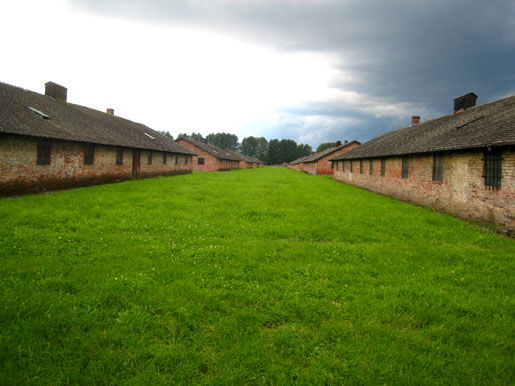
Some of those still-standing brick barracks are closed up but you can peek in the windows, which we did, and which gave me stomach pains. But there are also few that you can actually go inside, and that was a master lesson in humility, perspective, and many other things.
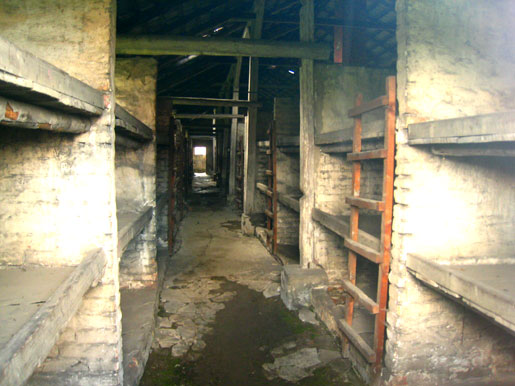
It only took about 15 minutes inside one of these barracks for my actual experience of life to change. I wandered around in this place that human beings were forced into, with no sanitation or blankets, starving and forced into slave labor all day, made to sleep on wooden planks, shoved up against strangers. The roofs had gaps between wooden slabs, the floor was dirt and concrete – can you imagine this place in the cold rain or snow of winter? There was only one stove in each huge barracks building. How completely horrible it was.
And through it all, they could smell the constant burning of the corpses at the other end of the camp. The terrible irony is that the ones who had to survive in those barracks were the only ones who had any chance, because all the rest of the millions brought in on the trains went directly to the gas chambers.
Where some of the side streets lead off from the main train-track central area, there are large photos posted so that you can see what was happening in the same area during the war.

You can click on that for a larger version to read it.
The Nazis attempted to destroy evidence of their crimes against humanity by using explosives on the gas chambers and crematoriums before they fled Auschwitz/Birkenau, when they knew the Soviets were near. They managed to do this to a degree, and here’s what is left today:
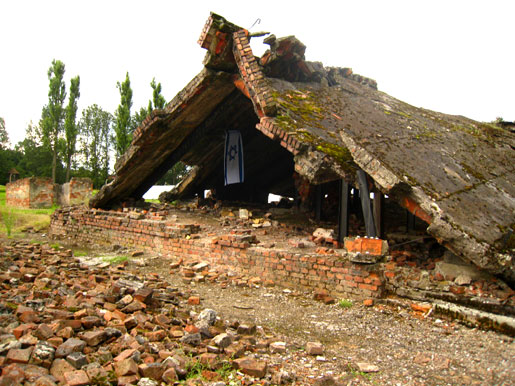
There are “ash ponds” where the Nazis dumped the cremation products into water to use later as agricultural fertilizer.
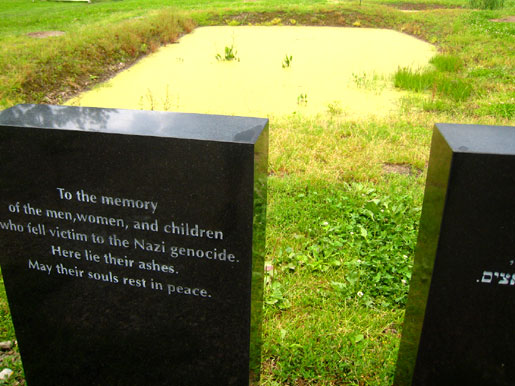
In the huge area between the bombed-out gas chambers, at the furthest back edge of Birkenau, there is now a memorial area that’s mostly paved, except where the pavers let through some of the rows of the old barbed-wire posts.
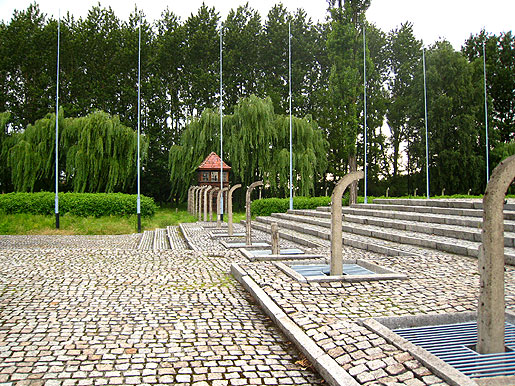
Soon after we finally reached that furthest point of the camp, which took a while because the place is very, very big, the lightning started overhead, here came the rain, and we had about 15 minutes to catch the last shuttle van back to the main camp, from whence we would have to catch the coach back to Krakow. We had to run in the rain through the middle of the camp, along the rail tracks that came from all over Europe directly to the gas chamber doors. Back through the main gate and into the shuttle van. All I could think about was how lucky I was that I could run out of this place and no one could stop me.
The sun came out again on the coach back to Krakow.
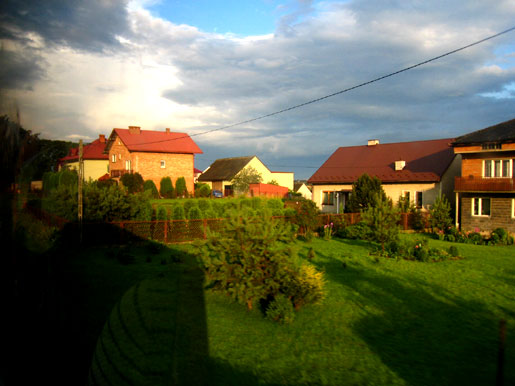
My God, the genuine prettiness of the surrounding area. You think of Auschwitz, or Poland in general after the Nazis invaded, and you think of bleakness and dreariness. Dark dank sickly winter, snow and death. But I took that picture five minutes away from the camp, and there is little doubt in my mind now that it looked generally the same way 65 or 70 years ago, at least during the summers. The green grass and the bright sunshine didn’t disappear in 1939 and magically regenerate in 1945.
It cracks the heart open to fully comprehend that things like the large-scale industrial genocide that happened at Auschwitz-Birkenau took place in the middle of a perfectly normal world like we saw on that bus ride. It didn’t happen in hell, or in some bleak desert, or any permanently winter-bound nightmare landscape where you can explain away these things more easily. It was just in the middle of this gorgeous countryside.

Something about that day in that place made me realize that if I don’t appreciate every single moment of my comfortable life, then I am an unforgivable ass. I don’t say that lightly. It is a real thing. All of us who are able to write or read blogs have it easy by any measure and we are fools if we don’t actively appreciate every single morsel of freedom and plenty that we have.
Thank you, that was beautifully written, your sharing is appreciated.
Thank you. Your eloquence is moving. Thank you.
An amazing post. Thanks for sharing this with the world.
Thanks, Rachel, for a brilliant post.
I’d like to go there myself one day. Well, maybe not like, but you know what I mean…
amazing photos. The sunlight/thunderstorm lighting is always dramatic, maybe it captures the sense that it is just somewhere – could be anywhere – their current ‘pastoral’ exteriors, and yet they are the setting of unfathomable evil and human drama.
Your post is a good reminder that we spend a lot of time and emotional energy sweating the small stuff.
Rachel,
Thank you.
It’s a good thing that I don’t have to say anything out loud right now, or dictate even this sentence to make the comment, because I’m not sure that, right now, I could.
I thank you for it.
Thank you, Rachel. I didn’t get to visit this place, but did visit Dachau when I lived in Germany. It was a most disconcerting visit, I must say. Friends had come to visit, and we had rented a car. We drove down to Dachau on a bright, sunny day in summer. I never really noticed it at the time (except for the threat of rain), but all the photos that I took that day were of a place that was cloudy, overcast with a hint of rain as well. I talked with several people who had also made the trek, and they tell me the same thing. It didn’t seem to matter how nice the weather was, if was different THERE! Always! I guess the places have an aura of despair, cloudiness, gloom really. I think that you captured that “aura” in your story and photos.
Thank you. That’s all I can say.
Well done, Rachel, well done.
Beautiful post. Your comments about the beauty surrounding these places of death reminded me of another blogger’s comments on evil in the world. You might enjoy reading Jennifer’s take on evil among us here:
There are other posts, but it was really interesting to read this particular one. (Who am I kidding? I read nearly every post she writes, but this one relates a bit to your questions about the Holocaust and good and evil.)
Thank you for sharing this.
A train ride into history. Where others perished, you came out alive and even more aware of what they sacrificed. Their memory is something we must never forget nor reduce to a still silence. Thank you, Rachael, for a moving visit that I will never be able to make but now can share with you.
Thank you, Rachel, for finally taking the time to get this post put together. I know it must have been difficult, but we appreciate it very much–I’ve been looking forward to reading ever since you said you were going to Poland.
I think in some small way you’ve done a great service to the memory of all those thousands of souls who rest there, as a lot of your readers may never have a chance to visit.
Damn, Rachel. That post was worth waiting a month for.
Thanks.
My heart breaks.
“…we are fools if we don’t actively appreciate every single morsel of freedom and plenty that we have.”
Amen, Rachel. And yet, that’s the way of it. Memories fade, and life goes on, and that hottie on the bus was definitely checking me out. I hope that enough adults take time to remember, and do what they can to ensure it never happens again.
Sadly it did happen again, in the 90’s in what was called Yugoslavia, albeit not on such a scale. Sometimes I think our species really sucks. But then I remember the other stuff we do (your other posts have mentioned some of that), and I cannot totally despair.
Our species doesn’t suck. Just realize you’re responsible for protecting you and yours.
Bless you. Beautifully written. I held my breath through most of it.
That such evil took place so recently is still something I can’t really comprehend.
I understand the need for such memorials and museums as a reminder of man’s capacity for evil and the need to prevent it from ever happening again. We’d be fooling ourselves to think that mankind has somehow evolved so greatly in the past 60-odd years that such things could never, ever happen again- or tomorrow.
Still, there’s a small part of me that almost wishes that all traces of these camps were completely and permanently eradicated. That these remnants of such unimaginable evil exist almost strikes me as somehow contaminating the Earth by their mere presence.
I’m not suggesting they be destroyed or diminished- not by any means. It’s just so… disheartening that they ever existed at all, with remnants still there today. Don’t ask me to explain.
Thank you Rachel. That was beautifully said. And this was a post worth waiting for. Thank you.
–John
Pretty much leaves me speechless.
I haven’t been to Auschwitz. However, I have been to the Holocaust museum in Israel, a country founded after Hitler’s attempt to exterminate an entire people failed. Not for want of effort, I might add. Anyway, the images were truly horrific. It’s hard for me to imagine that I share DNA with beings that evil.
Speaking of the ash pits: many years back when I was at Governor’s School, we were shown a series, originally filmed for PBS called the Ascent of Man, based on the book of the same name by Jacob Bronowski. Some of the episodes were slow, but the one about the Holocaust? It was gripping. Bronowski’s parents (I believe; it’s been 30 years since I watched it) and other relatives died at Auschwitz/Birkenau. He ended the episode by reaching his hand into the water and pulling up a handful of what was supposed to be ash, although I was uncertain how much had survived since that time. Stage or not, it had a tremendous impact on me and my friends. The memory is vivid to this day.
Well done.
No one could have written this perspective like you did.
How very moving…
Thank you.
This is why I read your blog. You are a thinker and a feeler with an extraordinary ability to express both.
Extraordinary!
Thank you.
Let us spit upon the memory of the Nazis forever. Let the heathen who wish to do this to us today be wiped from the face of the Earth.
thanks for posting this. your pics are amazing. i have not yet been to auschwitz, but have been to dachau. you put the feeling into words so brilliantly. it is difficult to explain the feeling of despair, evil, death of these places. the most disturbing part was the exhibit of the piles of people’s possessions. the eyeglasses, the shoes. it is disconcerting to see healthy living people milling about and seeing the normal neighborhoods surrounding these places. it can happen anywhere and we must remain vigilant. also, i think you take home an important message, every moment counts. material goods mean nothing. the petty little problems of everyday life don’t really matter. these lessons i also took away with me. i continually have to relearn them. travel has really changed who i am and i have come to appreciate the important things in life more. at dachau, there is a tiny carmelite convent at the very edge. my friend and i visited there. it was serene and the women were having prayer service. it was some positive in some place that is so negative. anyway, thanks for the post. it is difficult to explain the place and how it can affect you.
What a lovely memorial Rachel, of a horrific event of crime against our own people. I met two sisters, (German even) now passed away, who had been part of the experimentation process. Awful things they couldn’t speak much about. But they were grateful for their modest home & modest living and they never left each others side until death. It all makes me cry still.
Stunning.
Thank you.
Thank you Rachel.
A wonderful post. The thing that makes me saddest is the fact that so many in our current time would like to see it happen again. I guess at 70 some I will not be around to see the results of the seemingly world wide get the Jews agenda that is going on again now.
Wow.
Just, wow.
Thank you for your moving post. I don’t think I could’ve been able to even enter the gates. Your strength, and eloquence, is a source of inspiration.
I’ve read books and articles about the Holocaust written by historians and other deep thinkers, but this post, without any drama or hyperbole or grand generaliztions about the meaning of it all, has moved me in a way that few other things have. It’s full of shrewd obervations and insights, and was written with a keen eye for detail. Thank you for writing it. I consider it an instant classic.
Thank you, Rachel, for taking this trip and sharing it with us. You are truly gifted as a writer and photographer.
As for the stupid flirtatious girls, sadly, their lack of regard doesn’t surprise me. The stunning disregard for the memory of the dead never ceases to amaze me. Your recollection of their insensitivity reminded me of a picture of the young American student, Amanda Knox, who is on trial in Italy for the murder of her British roommate, Meredith Kircher. There’s a famous picture of her at a holocaust museum in either Germany or Poland, crouched down at a machine gun that was used to mow down innocent people. She’s collapsing with laughter as she poses next to this instrument of murder!?!? I can’t even begin to understand/comprehend …
Beautiful job Rachel.
My Grandparent’s best friends are Auschwitz survivors. Well he died 11 years ago but she is still living. She gives talks to schools. I am going to print your post up and give it to Mrs. Schwartz. I know she will be touched by your words.
Well-written. If I am ever able to express myself half as well as you did here, I will consider myself blessed. We must never forget that we are capable of great evil as well as great accomplishment.
That was really something to read. I may never get a chance to see it myself so I appreciate it when other people giving me a view through their eyes.
One thing that always strikes me when I read about the conditions people lived in while in concentration camps is a feeling of awe for those who survived. To suffer through such harsh treatment and come out on the other side alive and sane is truly impressive to me. I don’t think I could have managed it, myself.
Thank you for sharing.
Thanks for the time and thought you put into this very moving post.
A truely brilliant piece of writing. Thank you. And I really cannot say anything else.
Thank you Rachel. I’ve anticipated and dreaded this post. I too have read a lot about WW2 and about the camps, my first term paper (5th grade) was about Birkenau and my teacher called my mother, concerned at my interest in something “so depressing.” That was in 1971.
I’ll never go to Europe, never visit Auschwitz / Birkenau. I deeply appreciate you taking the time to craft such a descriptive and heartbreaking post on your experience at the camps. I know it was a very personal day for you and your sharing it with all of us is a gift.
It’s one thing to read a dry, scholarly account in a history book – it’s another entirely to read a first-hand description written by someone I “know” and respect. So again, thank you.
I learned a lot from your post, Rachel. I wasn’t familiar with some of the details, and I spent a lot of time looking through the various links you included. Everyone should read this. I thought I was humbled before – – knowing what I did know – – but this just blew me away. I’ve never read someone’s personal account of visiting Auschwitz, current day.
I probably won’t ever go there myself, but you have such a poignant and descriptive way of writing that I feel as if I were there with you.
Thank you for taking the time and such obvious care with this post, Rachel. The photos, your thoughts, and the additional sources you cited are going to stay with me for the rest of my life.
I read “Night” in a class I took two years ago. I’ve read a lot of literature, memoirs, and even graphic novels about WWII and the concentration camps (“MAUS” is one of the most well-known). I know that I would have to actually stand there and look at all of that to “appreciate” it. I also know that I wouldn’t have the stomach to do so, and I’m a little ashamed of that.
Thank you for the post and the photos. It’s sobering, to say the very least.
Wonderful and insightful post Rachel, you did justice to yourself and those that perished in the Holocaust.
Have you ever read the works of Corrie ten Boom?
They are epic works of hope and belief in Gods love written by a Dutch Christian Holocaust survivor.
(even if one has no great belief in a deity)
Here’s a link to her write-up at Wiki, after your recent expeience it might be a good thing to read.
Ken
I spent my junior year of high school attending a German gymnasium (high school) as an exchange student. During that year we American kids were taken as a group to Berlin for a week. We visited Plotzensee Prison, where Volksgericht prisoners were taken for summary executions. As you enter the grounds, there is a large (several feet in diameter) urn with ashes of those murdered by the Nazis. There is a room with 8 meat hooks hanging from the ceiling where people were hacked to death; the concrete floor is permanently stained with blood.
We American kids were completely overwhelmed. None of us could speak; most of us were weeping. But a group of German schoolkids that arrived when we did were carrying on as if they were at an amusement park. I stopped one of those morons and asked him, “Does it bother you that your grandparents could have done this?” He shrugged me off and went on his way. That night our group all got very drunk and tried to make some kind of sense of what we’d seen.
That place will inhabit my nightmares forever. I’m glad that you got to see Auschwitz, and can definitely empathize with you about its impact on your worldview. Someday I will take my children there, and make sure they understand the meaning, the absolute imperative, of the phrase, “Nie wieder!”
Thank you for sharing this with us.
Thanks for the account of your trip. I’ve heard people tell me that they reacted to Andersonville, in Georgia, much the same way…that there was something in the site of the old prison pen that just got to them, even on a sunny Georgia day.
At least the Nazis’ camps are open for visitors. I wonder if anybody will ever open the old GuLAG camps, or the Laogai, for tourism in memory of the millions who died there?
there must be a special place in hell reserved for the years 1914-present. *i am in no way* diminishing the guilt or the monstrosity of the germans for what they did at auschwitz and all the rest: the world has rightly damned them, and their descendants for it. it’s a debt they can’t ever repay, and rightly so.
but at least they admitted they did wrong, and said they were sorry. even if they don’t mean it, (maybe they do, maybe they don’t. depends on which german you ask, has been my experience.), they teach the horror of the holocaust to their kids. even if they don’t really want to,(see earlier parenthetical), they admit they did wrong. they own up to it.
pretty much nobody else does – and there’s plenty of guilt to own up to.
the russians killed 6,000,000-10,000,000 ukrainians in the early ’30’s. stripped the country of food, and sealed the borders. 8 million people, plus or minus, starved to death. moms and grannies and babies and doggies and kitties. plus another 20 million or so of *their own* people, killed to make stalin feel more secure. oddly, this isn’t taught in grade schools. the russians admit no guilt.
the japanese did in china pretty much what the nazis did, just on a somewhat smaller scale. particularly in the nanking campaign, they set a standard for brutality which horrified even the *nazis*. their special military unit, unit 731, committed among other crimes bacterial and chemical warfare,(they bred bubonic plague rats and then turned them loose in a nearby city), vivisection on live prisoners (the guards called them “logs”), rape on a mass scale, torture, human medical experiments….the list is endless. old men, young girls, shy and gentle schoolchildren. babies used for bayonet practice. oddly, this also isn’t taught in grade school. guilt? LOL. the japanese politely change the subject when this is brought up. it was so long ago. things were different then, you see.
mao killed 60,000,000 or so of his own people in the ’60’s. (that’s roughly all the people in the metro areas of NYC, chicago, LA, houston, philadelphia, the DFW metroplex, san antonio, phoenix, and the twin cities, **combined**.) pol pot killed *a third* of his country. sub-saharan africa is a charnel house, has been for decades. rwanda, the congo, sudan…no comment. doesn’t seem to matter. not taught in schools.
the real horror of abominations like auschwitz is that, going just by numbers, what happened there was small potatoes compared to other atrocities in other places. even worse, to me, is the fact so few people know about the less-notorious butchery. to amend the famous quote, the lights in europe and most of the rest of the world went out in 1914…. and we’re still cursed with the darkness.
lastly, one reads that the north koreans have nukes; the iranians soon will; as will the burmese and anyone the pakistanis sold some to. using the last 95 years as a guide, what do you suppose the near future might be like?
Wow Rachel. Just wow.
Reading stuff like this makes me think that I should abandon my own attempts at blogging. I could never live up to such eloquence. Its why I enjoy reading your writing so much.
Rachel, this is the most profound and deeply worthwhile blog post you’ve ever written, and that’s saying a whole lot.
Damn. Just…damn. It’s hard to fathom human beings doing that to other human beings. It’s hard to believe anyone emerged sane from the experience. I can barely look at the photos without tearing up; seeing it in person would completely undo me.
I have never been so truly thankful that my Jewish ancestors chose to emigrate from Germany to America in the late 1800s. If they had not done so…
“where animals like Dr. Josef Mengele tortured and killed women and children”
but mostly men. Fathers. Teenagers/young men, like my own sons.
ErikZ Says:
Our species doesn’t suck. Just realize you’re responsible for protecting you and yours.
And that’s the problem. We look out for us and ours and do not care about the ones who are not alike. That’s why I shudder when I read comments here about Muslims and their “cult” and their “towels on their heads”. I am born and raised post-war but I was raised and educated about our (German) history, as my children were at a young age. My only religion left was the one called “respect”. People are not like me, think differently, have different beliefs? Shocker. No reason to feel superior. No reason to treat them any different then I want to be treated. No reason not to respect them. If we would look out a little less for “ours” and a little more for “them” there might be a little more hope. Thinking about what nom de guerre said in the post above and reading the news everyday (and what’s not in the daily news, like Dafur, Chenya etc.) I doubt it. People are quick in condemning the Germans who did close their eyes in WW II but very ready to close their eyes themselves if not they or theirs are involved.
I haven’t made it to Auschwitz-Birkenau yet. I had almost the same experience at Dachau. The most sobering moment came when it finally hit me that Dachau was the first of the Concentration camps. The one where the guards for all the rest were trained. And one of the last to be liberated. It didn’t have the scale of Auschwitz-Birkenau*, or the modern notoriety, but to know that it was there that the atrocity began was too much.
*That is not intended to say that because not as many people died at Dachau that it was somehow less brutal. The fact that 1 person died at any of the camps is too much.
Thanks for that Rachel. As awful as it was to read, it’s clearly necessary, and I appreciate your efforts to share it with us.
Please, help me understand something a little better, though: I cannot wrap my head around the standing cells. You said they were three square feet, and four people would be crammed within each one? I can’t see it. My brain will not conjure up the image. How is this possible? How could one person fit in such a small box much less four?
Are you sure they weren’t larger than three square feet? It just doesn’t seem possible.
Wow. Just — wow.
Excellent post. Beautiful photography.
This is why rachelucas.com is my daily stop and read.
(that, and the dog and cat posts)
Thank you. I learned.
That was difficult to read, I can’t imagine how difficult is must have been to be there. Thanks for being there for us and sharing it so eloquently. It was moving.
Wow. Really, wow. I felt like I was there, and for that I thank you. I have been to the Holocaust Museum in DC years ago, and the exhibit of the belongings of the victims is horrifying. The shoes, the glasses, the hair. Awful.
I have been very much into the BBC documentary “WWII: Behind Closed Doors”. Fascinating look at Stalin and the special brand of horrors he inflicted on the world. It’s especially interesting to learn about how he, Churchill and Roosevelt were splitting up Poland, like slices of pie. Just so horrifying. I have not read the book but have it from the library:
Rachel,
Wonderful, wonderful post. Thank you for using your considerable powers of communication to share that with all of us.
In numbers, it’s 175 hectares in area, which is about 430 acres.
A hectare is 10000 sq meters, or 100 meters squared.
Here in Houston, the downtown streets are laid out 16 to the mile, which makes them very close to 100 meter spacing.
So, picture a hectare as an entire square city block. Then imagine a bit over 13 blocks squared, and you can visualize 175 hectares, and begin to grasp its’ size.
–
Thanks for sharing the pix. Something I remember reading in Man’s Search for Meaning is the beauty of the Bavarian landscape around Dachau.
Wow, thank you for sharing. Thank you for finding the words to express such a strong emotional time.
I appreciate how hard this was to write, Rachel. My family moved to Israel when I was a little girl, and we were raised celebrating Jewish holidays instead of traditional Christmas and Easter, etc. I grew up reading Corrie Ten Boom and Elie Wiesel and many others. Knowledge of the Holocaust was sown into my consciousness at a very early age.
When I was stationed in Germany as a young Army officer, I knew that it would be necessary to visit Dachau. I postponed it as long as possible, knowing it was going to be one of the hardest things I did in my young 22 years (at the time). My fiance and I made the trip two days before I was scheduled to PCS out of Germany.
Reading your experience at Auschwitz brought back all the memories of my visit to Dachau. Our experiences, though separated by time and distance, are identical.
I will tell you the two things that starkly stood out to me during my visit to Dachau. First of all, the concentration camp is right in the middle of a charming town. It is not out in the country, or hidden/camouflaged, as I had always imagined. There was a little cafe and bakery across the street, with people sitting outside with their dogs, and lovely cobblestone streets lined with homes. A low wall encircles the horror within – and by low, I mean low enough to throw food over, or to climb. I was deeply shocked. There is NO WAY the citizens of that town did not know exactly what was going on inside those walls. NO WAY.
The second thing that stabbed my gut was a huge wall in the main center that depicted in pinpoints of light all the Nazi concentration camps and their numerous subcamps. It was a constellation of gruesome proportions. There were not a few dozen or even a few hundred camps – there were over 15,000 scattered across Germany and occupied countries!!! 15,000! They were all located near or in population centers. The Nazi horrors were no secret to any man, woman, or child in those countries. There is no one who could claim they did not know. It shocked me to my core.
I remember walking in to Dachau feeling very cold and sick inside. I was on the verge of tears before I even set foot inside the walls, and I was offended by some European teenagers that acted like they were on an adventurous holiday. I felt they were desecrating the place with their silliness. I was relieved to see them later huddled on some steps, sobbing. There is no way to remain unaffected inside Dachau – the inhumanity is overwhelming.
Thank you again for bringing your unique voice to bear on the topic. I don’t think you even realize for how many you speak. What a gift.
Wonderful post. We should be reminded of things like this every so often to appreciate what we have. Thank you.
@ nom de guerre
I agree that the horrors visited upon mankind by communism are not properly taught or discussed. I believe it is deliberate. There are those who still intend to yoke the world under communism. It does not suit their cause to remind the people of the evil inherent in the communist system. Thus, textbooks and news and media ignore communism almost completely.
Here is Texas, a new curriculum was introduced that glossed over communism and the Cold War, and failed to mention Ronald Reagan and Margaret Thatcher completely. Instead, Gorbachev was given credit for dismantling the Soviet apparatus. We’ll see if that curriculum passes muster with the TEA (Texas Education Agency).
Communism did not die when the Soviet Union collapsed – it only evolved. And it morphed into what we see going on in Washington DC at this very moment.
Have you read Witness, by Whittaker Chambers? I read it as a young Army cadet ages ago, and have reread it again this summer to remind myself how insidious and prevalent Communism is in our own government and society. The tentacles run very deep and wide – much more so today than back in the 1930s and 40s.
In a day and age when it’s COOL to be communist again, when our communist-mentored President is nominating open and self-described “radical communists” to positions of unaccountable power, then America is in deep, deep trouble.
DEEP trouble.
I’ve been to Sachsenhausen outside of Berlin, fully intending to take pitures. I took two, it was just too emotionally draining to do anything more than walk around numbly, seeing the sorrow there.
Never Again …
This may be the finest blog entry you’ve ever written. The words and photos are very powerful.
Best regards
There are no words.
wow. excellent post. it sounds exactly like my experience/reaction when visiting dachau a few years ago, but my isn’t nearly as eloquent. and my aren’t quite as impressive. it is unbelievable to walk into a place and feel the evil and despair in the air.
Thank you, Rachel.
A beautiful, eloquent, and moving post. Thank you.
I have visited the National Holocaust Museum several times, and the part that always causes me to weep openly, without fail, is the display of shoes.
I can’t believe I held it together and didn’t cry as I read this. My stomach is still clenched though. I’ve also always been ‘fascinated’ by WWII and the Holocaust and I do plan to someday travel to view these things in person. Though it definitely won’t be a six flags experience. I went to the Holocaust museum when I was in high school and even then got ticked off at people acting inappropriately. And they have shoes there too…staggering and unimaginable. My child WILL know about these things – that there IS evil in the world.
Thank you so much, Rachel. That was beautiful, and the pictures are just breathtaking.
Hello Rachal. I’m new to commenting here, although I’ve been lurking for a few months. Your posts can brighten anyone’s day, certainly do mine.
Today I have to comment because I think your post about Auschwitz is possibly one of the best I have ever read. Clear, concise, honest, with a message. I think I am correct because the other comments here reflect sober thought on a terrible subject that we none the less cannot escape. So, thank you, from the depth of my heart, for the story and the post.
I’ve never seen Auschwitz, nor even been to Poland, but I’ve been to war in later times. Everything you’ve said rings like a bell in my mind, a bell than sometimes fails to chime in these frustrating times.
Thanks for just being and for being you.
It’s very rare that a blog can bring tears to my eyes. I didn’t expect it. Perhaps the ‘Hillbilly’ moniker misdirected me.
I’ve found that when I’ve been disturbed by people who react inappropriately to things, like those French tourists, it’s best to start by giving them some benefit of the doubt but to start asking nondirective questions, like “What did you think of the place?”. Sometimes people confirm my suspicions, but sometimes I see things their way.
I can imagine those laughing ‘tourists’ were professional tour guides who go to the camps a lot. But I can also imagine they’re simply pigs.
Rachel
Thank you…thank you….for writing this message.
I spent a full day at Auschwitz in 2006 and your description exactly matched my feelings at every point….including the tears upon seeing the glass displays. I was struck by the behavior of the people. There was quiet talking by various groups and couples until we got to the glass displays.
Suddenly there was silence.
The feeling was of numbness…being stunned by an unexpected physical blow….it WAS physical right into my gut and everyone else.
And then….I could hear the quick sobs throughout the room…stifled because no one wanted to make a scene. I’m 70 YO and I’ver never seen such overwhelming feelings suddenly displayed. Nobody could stop themselves.
I’ve been to both Dachau and Auschwitz. I will never set foot in another Nazi camp. I don’t need to now. But….I believe it is something every person who has the means and opportunity should do. It changes your view of life. It did mine. I believe it did yours also.
Doug
Again Rach, you’ve managed to put a tear in my eye and a lump in my throat with your insightfullness and emotion laced words. All done with thoughtful introspection. Thanks
I had a similar, though not as profound, experience going through the Holocaust Musuem in DC. It’s lighter because everything is so far removed from the scenes of the crimes. The walls of shoes, luggage and hair are there also. As is a presentation of what sorts of tortures and medical experiments they performed. It was an overwhelmingly awful and good day.
Thank you. This post was both moving and informative. It gives true light to the meaning behind the words, “NEVER AGAIN.”
Rachel,
Incredible post. There are monsters in this world, it is our job to make sure they never see the light of day. Peace.
The Holocaust exhibit at the Imperial War Museum in London had a similar effect on me. It was life changing. If Nazi concentration camps aren’t enough to convince somebody that evil exists, then I don’t know what would. Thanks for sharing your experiences.
Never again. Never.
What’s sad and disturbing isn’t the shoes or the baby clothes or even the blood-stained floors at Dachau. Those are just things.
What’s sad and disturbing is that Kim isn’t going to get his wish. Yes, I know he phrased it as a solemn vow. The problem with vows like that, with “death before dishonor”, is that it soon divides humanity into the dead and the dishonored.
It will happen again. As several people have pointed out, it’s happening now. It’s not going to stop. And if that doesn’t validate the concept of Original Sin to you, I’d rather not know you.
Regards,
Ric
Thank you for sharing that wonderfully written piece.
My grandfather was with one of the units that liberated Dachau. He never spoke to anyone of what he saw there; I suppose there are some things, as H.P. Lovecraft noted, that are better not to have seen.
And while I am profoundly skeptical of the supernatural, every person I have ever spoken to who has visited one of these camps has said the same thing about them — that there is something intrinsically /wrong/ at these places. Some stains can never be washed away, I think.
Rachel, thank you for one of the most eloquent descriptions of a solemn journey of this type that I’ve ever read. A few thoughts:
1) I’ve been to Dachau, to the US Holocaust Museum and to Yad VaShem. You are utterly correct, nothing in the world can prepare you for, or is like, actually being in a locus of Evil like these camps. I actually went to Dachau with a friend of mine in the US Army at the time, on my way back from Israel and my first visit to Yad VaShem. No comparison – and Dachau was “merely” a political prison and not a death factory.
2) My wife’s uncle is a survivor, and the tatoo on his arm is from Birkenau. His entire family was murdered by the Nazis, including his father and brother in front of his eyes. He doesn’t speak of this now, but some of my wife’s older cousins know the stories. Your photos and your words are magnificent in their descriptive abilties, but they don’t hold a candle to actually having been there WHILE IT WAS HAPPENING TO YOU AND YOURS. No, not even being there as a tourist – but, of course, you know that. So say the very brief and incomplete words of my wife’s cousins. Nonetheless, thank you – if this gives your readers even 1/10th of 1% of the experience of being there, then it will have succeeded in transmitting the horror of these events, and may help to prevent a new occurence of the same.
3) What you saw that was so common is the “banality of Evil” of which Hannah Arendt wrote. That banality is what is REALLY horrifying – that ordinary people with otherwise ordinary lives did these things is far worse than the scariest, bloodiest horror movie that Hollywood can dish up. It is utterly horrifying because it happened by the hand of ordinary people…meaning that it can happen again. It was and remains a primary motivator for me to maintain a number of firearms, and to be well-practiced with them – I’m not getting on any cattle car. Oh, and my wife’s uncle is apparently of the same mind, because he is NEVER without a gun in his possession.
4) Fuck the deniers. Really. They should all burn in Hell or, better yet, be locked in the standing cells or suffocation rooms for a while – a LONG while. Folks, this happened. Its not just the photographs, or the tattoo on my uncle’s arm that proves it, no, it is the haunting stare of my uncle whenever any topic even remotely related to this comes up. To this day, this toughest of men I’ve ever known is scared to be alone – one can only imagine what must have happened to him on one or more occasions when he was alone. This is no fairy tale, no politically-contrived fable – it happened.
Why….how….
Kim du Toit Says:
“Never again. Never.”
Kim, the correct statement is:
“Never again – but IF again, then not for free.”
Thanks for your sentiments – as a Jew hearing that from a gentile whom I KNOW means it, that is very, very comforting. Knowing that you are far from unique in this regard is even more comforting. Still, I’ll keep ahold of my guns, and train my kids to use them in a couple of years. But thank you.
P.S. Kim, when are you going to start blogging again – there are thousands who REALLY, REALLY miss your view of events, including this armed Texan Jew.
I love you.
There’s an exhibit at the holocaust museum in Jerusalem where you walk through a dark room lit only by candles and mirrors, and a voice reads the names of the murdered children aloud. It’s 1.5 million.
Rachel, thank you so much.
My reaction to the first photo: “My God — it’s so… pretty.” It’s as if a part of my brain expected the green, growing things to somehow “know,” and mute themselves accordingly.
Thank you for giving us the opportunity to help carry these memories.
I’m waiting to see if it becomes the new, mandatory national history curriculum.
When I was younger, I was mystified at how few people seemed to realize the horrors that communists inflicted on the world. As I got older and less naive, I came to believe, much like Redheaded Infidel, that this was intentional. I become even more convinced every day.
Rachel:
I’m one of your old school readers, hanging around each of your blog incarnations. Your impudence and ordnance, along with your sense of humor, are what usually kept me coming back. But the reality is that your a damned fine writer. This post provides ample evidence of that. Thanks for sharing.
Rachel, you put a lot of writers who collect fat paychecks to shame. Just keep writing please.
Thank you for this post, Rachel.
@nom de guerre
I think the reason that the Holocaust sticks in our minds and overshadows the Ukrainian famine, the Great Leap Forward, or even the killing fields is two-fold.
First, Americans fought a great war to stop the Holocaust.
Second, it’s the damned ruthless efficiency of it all. I mean, sure, Stalin slaughtered millions. But it wasn’t an assembly-line process. The Holocaust was carried out with mechanical precision. And that just makes the mind bend.
Rachel – wonderful post. The picture of Block 10 – it just looks so… normal. It’s just like any other building, isn’t it? And yet…
I don’t know that I’d be able to visit such a place. It would be difficult for me to restrain myself around the locals. I just want to grab them and scream at them: “How could you let this happen in your F*@!* BACK YARD?”
It’s as though all of Europe was consumed with insanity.
Thank you for your words. We will each take them and apply them in our own way, to our lives.
You nailed it.
Thank you for sharing your pictures and comments. I pray this never happens to anyone again. May all who see this learn from it.
Very moving. Thanks for sharing, I needed some perspective this week, and wow, did I ever get some. Beautifully written. Whoever said you put the paid writers to shame wasn’t kidding.
Excellent post, Rachel. I don’t have anything to add. I’ll have to re-read it because there is a lot to take in.
Redhead Infidel nailed it, too:
It IS happening again, and this time it’s right under our noses.
Thanks for posting so much detail. That was very interesting, but also horrible.
When Schlindler’s List won an Oscar….a lady who was a concentration camp survivor got up and spoke and one of the things she said that really stuck with me was (paraphrasing): “Never underestimate just another boring evening at home”.
Instead of griping about being bored, be thankful you have a peaceful night at home with no one bothering you….or doing much worse than that.
Thank you so much for this post.
Leaky eyes, I have leaky eyes.
Thanks for sharing a very moving posting. I’ve been to Dachau and have had the same opinions/observations. Even in a sterile condition with most of the buildlings torn down, it is still a very sobering place to visit.
Thank you for this, Rachel. Beautifully written and devastating.
Wonderful post!
My wife and I just left Krakow a few days ago and visited both camps as well. I will save this post for her to share as well.
Please follow the link below for the photographs that tell more of the story of the camp. The inhumanity. Nothing like the liberation photographs, these just show people being sorted and waiting for their fate. From all over Europe, helpless yet human
Rachel, thank you so much for this. I will be sharing this with family and friends who lived in Europe and will, no doubt, appreciate what you’ve graciously and eloquently shared with us. I felt like I was there with you.
Keep writing!
Thank you, Rachel.
I have the same thoughts I had after I visited the Holocaust Museum in St. Petersburg, FL. How can human beings do such things to each other?
Thank you Rachel, for a wonderful account.
When humans become less than humans – when humans become just another competitive species -when humans become a commodity of only market value – when convenience or cost reduces our preciousness before our Creator – this is the inevitable result.
Interesting that before this atrocity, the Nazis were eradicating their own undesirable people by using doctors to solve that problem too.
Until we understand that evil is a force seeking to destroy each of us, and that without turning to God, it will win. These monuments to fallen man will continue under a million different names.
Wow. Just wow.
DId anyone there suggest it become a spot for a national service day?
Just sayin………
Thank you.
Fantastic post- thank you so much. If I may add one thing- the “Arbeit Macht Frei” gate was modeled after the original that still stands at the first Nazi death camp- Dachau. (Paul from Texas- your comments are well taken, but in the big scheme of the German SYSTEM of camps-they were all “death” camps-some just more purposefully designed than others). Like Auschwitz, it has a TINY gate and located smack dab in the middle of town, as it was in the 30’s and 40’s. The typical German excuse of “I didn’t know” is clearly a falsehood. To this day, sickeningly, the Germans use the non-museum portions of Dachau as a training ground for the stadt polizei. Thanks again.
Rachel,
This was incredibly heartbreaking, touching and horrible all at once. Thank you for sharing your experience. You write beautifully.
Many people are dismayed by the Hitler mustaches being drawn in the current political climate. I see it as abject terror rather than disrespect–terror that we have not dealt with. It’s as if the concentration camp survivors walked the earth and left footprints that are still fresh, and we step in them and carry the dust on us and we don’t know it’s there consciously. We know it subconsciously, we know it deeply, but in this frantic now-now-now world we have never dealt with it. We have brushed that dust off and said “Oh that was so long ago…”
But it wasn’t. It was not long ago.
And until we can collectively assimilate it to the level anyone can assimilate pure, undiluted, unmitigated Evil, the dust from those footprints clings to us and we try to ignore it but it lives in us, still, and perhaps will for years and years. Perhaps it should, yet, for years and years and years.
I have read and learned, and prayed and tried to understand. I don’t think anyone ever can, not totally, but what I have understood is that in Auschwitz we see the endgame of hatred. It has taught me that what starts as degradation ends with lorries, barracks and gas chambers. It has brought me a resolve to never slaughter another person: not in word, not even in thought. For every time I demean another, I put in place the shadow of barbed wire, a single brick in the pavement, a section of rail for the train cars that led to such unspeakable atrocities.
I want no part. With God’s grace, I say no. I say, please, God in heaven, never again. Never, never, ever again.
That affected me like nothing I have read since “The Gulag Archipelago.”
It is more upsetting because it is not inhuman. Somebody laid out those camps, measured the lines, calculated the areas and placed the guard towers. This was done with intelligence and a conscientious desire to do a good job. Somebody, probably many people, stood back and looked at it when the construction was done and felt warm pride at the quality of the work.
And these people were not as different from you and me as we would like to think. That should always remain with us, as a warning to be ever vigilant, and to never go down these paths again.
Rachel,
Awesome post, I believe it’s one of your best. The pictures and your words delivers an emotional gut-wrenching punch . Never forget, indeed. Thank you and bless you.
Dear Rachel, there is indeed an obsession to understand something that to this day defies explanation. After reading your post, I felt compelled to share a poem I wrote one night last year during one of those moments when once again I attempted to comprehend the incomprehensible. I hope you won’t mind my posting it here.
The Hole in the World
We come here willingly
Though you had no choice
To see for ourselves
The hole in the world
Where so many perished
A long time ago
Now, it is quiet
Though still we can hear
The sighs of your sorrows
As the wind stirs the leaves
On the branches of birch
That once held you captive
The brick walls have crumbled
That housed the abyss
Dimension of darkness
Into which you were thrown
Gasping for air
Inhaling death
The pond lies before us
It’s water a mirror
And in its reflection
We see the fell deeds
That fed fires of hatred
And turned you to ash
Over there are the tracks
In this hole in the world
Where the trains slowed and stopped
And generations departed
From the light of day
In the middle of night
Across the green meadows
Past Kanada we walk
To the courtyard of killing
Between 10 and 11
Where pale assassins
Condemned themselves to Hell
They wail there now
In the cells where you stood
Pleading for the mercy
They denied you and your kin
Asking forgiveness
When there is none to give
Your soul is now free
From the hole in the world
But your tormenters are trapped
In the dark of damnation
And we pity them not
For we remember…
My son is 10. I think it’s time for him to read about this. What better place to start than right here? Thanks.
Consider this article next time you consider buying a Mercedes, BMW or Porsche. Not only should this never be forgotten they should never be allowed to forget thier crimes or profit. The German people may have done a lot to attone for these crimes but it will never be enough, ever.
Beautiful post, Rachel. I can’t say anything else about it. Just wow.
I’m dealing with something personal right now, and this really helps give me perspective. Thanks.
Excellent article. Thank you. It reminded me of my visit to Dachau 25 years ago. Dachau — one of the first political prisoner camps — was much smaller than the death camps and was not designed for extermination. Still, being in that place evoked emotions similar to those you expressed.
Never forget. Never again. Never trust those who seek to disarm you.
I to felt everything you described but it was at Dachau in 2006. I still remember the feelings of “wow, mankind does suck” type of feelings. Your story is riveting.
My family and I (two older daughters) will never forget what we saw.
Thank you for putting into words my feelings.
Thank you. I don’t think I can convey how much your post has affected me. I, too, have been to the Holocaust Museum in Washington, D. C. and left feeling humbled by the experience. I cannot imagine my reaction to actually visiting one of these places.
I will definitely be sharing your post with my family.
I had sort of the same experience at Dachau about 13 years ago. The Dachau camp is located in the small city/town of Dachau, just north of Munich.
Can you imagine living there and having return address stickers that said “Dachau”? Having to fill out online forms and filling in “Dachau”?
I really think that the Allies should have preserved the camp as a museum and then razed the town and just planted grassy meadows.
Thank you for such a moving account. Although I haven’t been to Auschwitz, I felt I was there with you. I recently finished reading the memoirs of Rudolph Hoess, “Death Dealer: The Memoirs of the SS Kommandant at Auschwitz” and it is chilling reading the monster’s own words. Hoess was hanged in 1947 just outside the main gate of Auschwitz. One passage from his book reinforces your feelings of horror and sadness upon seeing all the shoes, particularly those of the children:
“Many women hid their babies under piles of clothing. Some of the Sonderkommando watched carefully for this and would talk and talk to the women until they persuaded her to take her baby along. The women tried to hide the babies because they thought the disinfectant would harm their infants. The little children cried mostly because of the unusual setting in which they were being undressed. But after their mothers or the Sonderkommando encouraged them, they calmed down and continued playing, teasing each other, clutching a toy as they went into the gas chamber.”
It was horrible. Never forget.
Hey Rachel,
I have written in response before to your writing on Poland. I’m an American who has lived here for 12 years now, with a polish wife and now two wonderful polish/american sons.
I’ve been to Oswiecim five times now. The first two times I went in and looked at the museum in its entirety. Each time after that I’ve gone with a book or my Bible (I’m a missionary) and used the time while my friends went in to sit outside near the parking lot and pray for the modern day families of those who lost loved ones in those camps.
The experience will change you, if you let it. The place is surreal and it is banal. What’s more amazing to me these days is a meeting like I had the day before yesterday.
I sat with a woman I’m helping who is 74 years old. She showed me pictures she’s collected over the years of her family, coworkers and friends. In one of the black and whites taken in the mountains in poland are a bunch of young, fresh-face, farmer-dressed young people and among them, also posing for the camera, a nazi soldier in crisp black and silver uniform. He had a big smile on his face. Seems he had become friends with one of the brothers of this woman and was actively courting one of the girls from the village.
We talked about the people in the pic. She told me what had happened to this aunt and that. As we came to the most strikingly beautiful of the girls in the pic, she said that aunt died during the war. I asked how. She said that the Germans had occupied the apartment block they had been living in, but let her family stay. One day, the came for the aunt – took her away and that was that (that’s exactly what she said ‘that was that’). She said she was later told by someone who had connections that her aunt had made a German officer mad and he had her sent to Oswiecim.
Life in the shadow of these things is not normal – it’s not our American history and way of being. It causes one to think differently when your aunt was killed in a death camp…and not peacefully passed in an Senior Center with their family around.
We do need to enjoy each moment of life, and thank God for His goodness to us.
corey
Wow, this was very thought provoking. I cannot wrap my mind around how any human could/can do this to another. My grandfather was there after the liberation, when his unit came through. He didn’t want to talk about it, and never wanted his army medals displayed. I feel like maybe he felt we should have gotten there sooner, and we didn’t do enough to stop it. You are a very good writer, and the mental images you provoke will be with me for a very long time.
Beautiful. How can that be my impression in response to writing about absolute horror.
One thought kept cycling through my head while I read this,
“Men did this to other men”
How does that happen?
Even for those who were children, or not even born, when these things happened? There’s a name for having a negative opinion of individuals who have committed no crime other than being born into an ethnic/cultural group you don’t like. Prejudice.
Assigning group guilt to Germans today for the crimes other Germans committed in the past is an awful lot like “they killed our Lord”-type justifications for anti-semitism.
Yes, I may be taking your comments personally because I’m of over 3/4 German heritage. My forbears conveniently moved to the US long before the Nazi stuff got going, but after slavery was abolished, and settled in states like IL and NE, so you can’t blame them for Jim Crow either. So I have no ancestral guilt over any of that.
Wow, words do not seem sufficient. I, too, have always been interested in all things concerning the Holocaust. My stepfather lost family members in those camps. I happen to be very involved with a youth exchange program and am amazed at what I have learned from the different students I have encountered from other countries. One girl, from Poland, was telling me about her home country shortly after she arrived in America, she stated that religion was “not too hip in Poland anymore, and of course there are not many Jews that live there anymore”. Appalled as I was at her statement, I asked her if she really understood what she had just said, and very flippantly she said, “Yea, the Germans took care of that”. The next year I had a boy student from Germany, who openly told me his grandfather had been a German soldier and still lived in Germany today. I understand there was a difference between and actual Nazi and a German soldier, but apparently, his grandfather was a POW in a Russian prison for several years during and after the war. This year I have an Argentian girl living with me, she claims she has never been educated about the Holocaust in her home country, she said she had heard the word Holocaust, but little else about it other than it happened during WWII. She seemed very interested in learning about it and I have spent a great deal of time this year teaching her what I know to be true about the gruesome details of mans inhumanity to man. We have visited the Holocaust museum here in Houston, and she has read Eli Weisel’s book ‘Night’ and has spent countless hours researching on the internet. I told her I was told many of the fleeing Nazis took up residence in Argentina, which made her cringe with disgust. Stange and sickening how the youth from different regions see the same situation so differently.
Thank you Rachel, I will be sharing your post with my Argentianian student this evening.
Rachel,
I had the honor of visiting Auschwitz/Birkenau in 2007, and was permanently and powerfully affected as well. As soon as we walked in the gate, my co-traveler and I removed our baseball caps. I don’t think we said more than a dozen words between us in the next two hours. Truly moving.
I went to Auschwitz in 2007. It was Tisha Ba’av (Who can eat and then view the camps?)You’re so correct about the surrounding beauty – the deep lush green of grass drenched and fertilyzed with Jewish blood.) But something I also noticed was the sky and clouds. There are many adjectives I could use to describe it; dark, brooding, but its more than that. It’s almost like the sky above Auschwitz will never stop mourning.
Rachel:
Have you seen this Holocaust Tribute?
Kol Tuv,
Moriyah
Rachel, I was able to get a sense that I never had before. Thank you so much. My great grandparents emigrated from Germany through Ellis Island. My father fought Germans on the front line in World War II, and would not talk about it.
The original Jerusalem Post page that first reported this story has expired, but the Little Green Footballs page that pick it up is still available.
JEWISH STUDENTS ATTACKED AT AUSCHWITZ
While on a tour of the museum at the Auschwitz death camp in Poland on Sunday, a group of around 50 Jewish university students from Israel, the U.S. and Poland were verbally attacked by a three-member gang of French male tourists.
Evidently incited by the presence of an Israeli flag wrapped around the shoulders of Tamar Schuri, an Israeli student from Ben Gurion University, the first assailant ran at the group while its members were being guided through a model gas chamber and crematoria and began swearing and hurling anti-Semitic and anti-Israeli insults.
“He told us to go back to Israel and said that we were stupid and should be ashamed to walk around with an Israeli flag,” testifies Maya Ober, a 21-year-old Polish student at the Academy of Fine Arts in Poznan and member of the Polish Union of Jewish Students (PUSZ), which organized the 16-day summer learning program along with the World Union of Jewish Students (WUJS).
After the initial altercation, a second assailant grabbed Ober by the arm. “One of the guys held me by the arm and wouldn’t let go,” says Ober, who lost several members of her family at Auschwitz. “I was afraid. I couldn’t move and I didn’t know what he was going to do.
”I was shocked. Although I have met anti-Semitism many times, I never expected to meet it at Auschwitz, where so many of my relatives were killed,“ she says she spoke to the assailants in French and that in addition to being ”brutish and vulgar,“ their sentiments ”made absolutely no sense.“
”Violence was narrowly averted,“ adds Laurence Weinbaum, Director of Research at the World Jewish Congress and resident scholar for the group, who says the Polish police were not notified of the incident because the assailants did commit an actual crime. ”But, if the two sides hadn’t been separated, it would have come to blows.“
Weinbaum, who has been to Poland more than 30 times on educational tours, says he never before saw anything like what happened, happen. ”It was simply shocking,“ he says. ”In some way, I felt that these men were satisfied to visit Auschwitz. This was another reminder that in Western Europe there is sympathy for dead Jews; it’s just the live ones that they cannot tolerate.”
Rachel, I know you went to Europe with an open mind. I hope it’s open to the possibility of evil resurgent. You’re in the UK. Watch the BNP. Closely.
Amazingly descriptive, thoughtful, and moving post. I have never been to Auschwitz, but like others who have posted, I have been to Dachau and experienced similar horror there. But the personal experience I had that most closely relates to your post involved Berlin and the Berlin wall.
I was in Berlin and at the wall in March of 1989 and in East Berlin on the same trip. I was there around the time some young people had been fatally shot trying to cross. Humankind’s inhumanity to each other was horrifying and the fact that life went on in West Berlin around a wall that was built literally in the middle of roads was stupifying. I truly did not believe I would see that wall come down in my lifetime and I vowed to never visit Berlin again – East or West – until it did.
When the Berlin Wall did fall in November of 1989, the people around me at my college campus who had not been there in person didn’t understand AT ALL my intensely emotional reaction. And when I visited Berlin again in 1998, it was stunning and emotional all over again. I recently learned that those people killed around the time I was visiting were the last to die trying to cross the wall.
Every single time I vote in an election, I remember Berlin and the wall and the people who died for the right to live as I have lived my whole life. When I went to vote in the 2008 presidential election, I took in my pocket a small, grafitti’d, facing piece of the wall that a fellow student who visited in 1990 obtained for me.
Thank you for your testimony and your powerful words.
Thank you for sharing this, it was very moving.
My father was a decorated Infantry officer in the ETO. Regarding his Silver Star, he has said that anybody who took one step forward deserved a medal.
God bless every man who took a step forward to end this.
Great job. Kind of makes it hard for the Holocaust deniers to claim it never happened, doesn’t it?
Your respect for the place and its victims is truly wonderful. Respect for such things seems to be regarded as silly these days and it frightens me.
Your observation about the beauty of the place and the incongruity of what happened there is frightening as well. The people who voted for Hitler and gave him his power were not all monsters. Many of them were just ordinary people.
We MUST remember this. They elected a man they thought was right and good and wound up accessories to mass genocide. We owe it to ourselves and our children to always be vigilant and on top of what is going on in this country, no matter who is running things, no matter what they say they stand for.
Safe Haven, Oswego, NY museum for the nearly one thousand immigrants that escape to the United States. It is the only one in the USA. Worth your time to read the book about Safe Haven and Ruth Gruber who was in put in charge by Franklin D. Roosevelt and great work to save all those people. Not too many people know about this rescue and how the people of Oswego reacted to this surprise.
In response to Jeff at 8:48 AM, your comments are also well taken. Perhaps I should have phrased it differently – camps like Auschwitz were death factories. They were purposely constructed with only one goal, to annihilate as many people (mostly Jews, though many others were also murdered in them) as quickly as possible. Camps like Birkenau were work camps – where, of course, most of the inmates died, but they lived for a little while, so long as they were useful and didn’t tick off a guard or officer. Camps like Dachau were primarily political. Yes, thousands died there, and many hideous medical experiments took place there, but it wasn’t purposely contructed in order to commit genocide. Though someone murdered in any of the 3 types of camps wouldn’t know the difference, nor would their surviving family, WE have to make a distinction – because the purposeful mass murder of a people is a higher order of crime than “mere” murder for political purposes.
Regarding Dachau, I have a story about my visit there 19 years ago. I flew in from my first trip to Israel to visit a friend in the US Army who was based near Munich. He was a bit late to pick me up, and while waiting I observed at least 25 people entering the airport with dogs. I found it a bit curious (these people were clearly not blind, so they weren’t seeing-eye dogs), and I asked my friend about it. He told me that the Germans are very, very attached to their dogs and bring them everywhere. OK, fine, by itself not too significant a fact. The next evening we went to a restaurant. While reading the menu, a family came in with their dog, and the dog lay down under their table. Again finding this curious, I asked my friend if the Germans had any kind of health code regarding animals in restaurants. He told me, “I told you they brought their dogs everywhere – now you understand.” OK, also fine – a bit strange to my sensibilities, but not too important. A couple of days later, on my way back to the airport, we stopped at Dachau. After getting out, I remarked to him that I found it incredibly paradoxical that the Germans were so in love with, and kind to, their dogs that they brought them into restaurants with them, but that the same culture could commit genocide and murder over 10 million people (not to mention the butchering of countless millions in the course of waging war against most of the rest of Europe). To this day, I cannot resolve the cultural insanity that allows for such a paradox. If anyone can explain it, please let the rest of us in on your insights.
Having seen Dachau personally, and feeling much of what you experienced, I feel I have seen Auschwitz as you have given a very clear and sensitive narrative that came from your heart. Thank you for sharing
I visited Dachau as a 16-year-old and that is still one of the strongest impressions on my life to this day, some 23 years later. Words and pictures cannot begin to describe the feeling of actually being in one of these horrible places, but you have done an excellent job in trying. Thanks for sharing.
Rachael, thank you for the courage to go to this place of evil and to write of your experience.
Like several other posters, my wife and I visited Dachau. It was a rainy day in the late 1970’s, just a short tram ride from Munich to the camp in the heart of the village. That revelation was astonishing to us – there could be no denying the fact that the German people knew what what happening in their midst. But like us today – some would have agreed with what was happening while others opposed would be afraid to act because they risked being sent there, too. We should guard against the courage that comes through time and distance…
We raised our daughter to value life and have a sunny outlook, but we also have shared with her those places that have had the most emotional and spiritual impact on us:
– Dachau
– Ann Frank’s house in Amsterdam
– The invasion beaches at Normandy
– The American cemetery in Normandy
– The Holocaust Museum in Washington, D.C.
– The USS Arizona in Pearl Harbor
– The Viet Nam Memorial
In my experience, each of these places creates a visceral reaction, a soberness, a need to pause and reflect. For each example of man’s inhumanity to man, there is the example of others serving courageously in the battle against evil.
I grew up knowing some death camp survivors, haunted as a child by the tattooed numbers on their arms. Sadly, our younger generation is mostly unaware and unschooled in these epic challenges between good and evil that mankind faced over the past 60 years. I fear that our national moral compass has been shaken and unless a battle against evil can be accomplished in weeks with virtually no casualties we won’t act.
“All that is necessary for the triumph of evil is that good men do nothing.”
I regret so much that I did not go see these places during the three years I lived in Germany.
My husband was able to go to the Holocaust museum when he went to Israel this past January and said that it was something you just could not get out of a book, and certainly nothing taught in school.
Thank you for sharing your experience so beautifully.
Last summer my wife and I visited Theriesenstadt, not far from Prague. This was the ghetto the Nazis established as a showpiece to convince the International Red Cross and other useful idiots that the information filtering out about the death camps were just “lies”.
In the Theriesenstadt museum are copies of correspondence between Hitler, Himmler and Eichmann expressing the importance of impressing the “neutral” visitors.
Eventually almost all of the ghetto prisoners were sent to death camps elsewhere.
In a nearby location is the Theriesenstadt citadel, an old fort which the Nazis converted to a slave labor camp for both Christian and Jewish political prisoners. Thousands died there. At this site in May 1945, just before the end of the war, guards marched a number of prisoners out of their cells, telling them they would be meeting the Red Cross. Instead, they were executed.
Thank you.
It was very difficult for me to look at the pictures and i have bookmarked this page for me to come back and look at. My mother and my aunt were brought to Auschwitz in May, 1944, along with their parents and siblings, except for one brother who was sent somewhere else. They came from Sighet, Romania, the same town as Eli Wiesel, who my mother knew as they were both children there.
My mother, who was 17 was separated from her family and grabbed her sister Ann, who was 15, the rest of my family, my grandparents, whom I would never know, and the remaining 5 brothers and sisters, down to age 3 or so, my aunts and uncles, were marched off and gassed to death. Their ashes presumably are still there and I would like to believe their souls are not.
Obviously my mother, her sister and her brother survived and I was born here in the USA in 1951. My father was a camp survivor from Dachau. I remember the stories my mother told me, and I also remember her screams at night from her nightmares.
I doubt that I will ever go there and I thank you for doing so and sharing this on your blog. I thank you for keeping my family alive in others memories so this horror will never happen again.
Thanks for the post and your recount of what was a difficult experience. I remember reading about these atrocities and was sickened and numbed by the scale and routine nature of them, a deliberate effort by the murderers.
Probably the most moving blog post I have ever read.
Wow. Just wow.
This has nothing to do with your current post. It has to do with Sunny. I am so sorry about your loss. I found your site about a year ago and loved the dog stories and pictures. I lost my Dad in April 2002 and my best friend
(chocolate lab named Hershey) in June 2002. God is not supposed to give you more than you can deal with, but sometimes he really pushes it.
I’ve never written to any one on a blog before, but felt strongly about your loss. Nothing any one can say makes it easier but I do feel for you.
Attached ( I tried to attach) is a picture of my new best friend (Tucker, 7yrs old, 114 lb sweetheart) who is in remission from cancer.
If I knew how to send you pictures I would love for you to see pictures of my baby.
Steve Hunter
I’m crying. You have just given me a sobering tour of the place my father in law called “home” as a teenager. I cannot fathom how he could have survived such an ordeal. Thank You Hotair for linking to this very important blog journal.
From 1900 to 1999, GOVERNMENTS killed 262 million of their own people. That is 6 times as many as those killed in wars between and within nations. Two Hundred Sixty Two Million people, killed by their own governments. My source is a web site on “democide” at the University of Hawaii, . 262,000,000. Murdered by their own government. This is why many of us in the United States “cling to our guns”. We know damn good and well that the only thing governments fear is force, and we have absolutely no intention of climbing tamely into the cattle cars to be shipped off to the “re-education centers”. My personal feeling is that I would prefer to die with my human dignity intact, taking with me as many of the statist agents as I can, rather than die slowly in a camp. And don’t tell me “it can’t happen here, we live in a democracy”. Tell that to the Jews who lived in a civilized democracy in the Weimar Republic, or the Russians who had a democracy for a few years until the communists took over. Personal freedom exists only until the government feels it is powerful enough to end that condition. If I do not have the basic human right of self defense, even against my government, then I am a serf. 262,000,000 murdered. Makes “gun control” seem like a great idea, doesn’t it? Worked really well for Hitler, Stalin, Mao and Pol Pot, didn’t it?
Rachel, this is quite simply the best thing I’ve read on any of your blogs. I’ve been to Yad Vashem, the Israeli Holocaust Museum, back in ’79, and I had the same reaction when confronted with the piles of shoes, glasses and clothes. It takes your breath away to realize they are all that’s left of their owners, who were long ago reduced to ash, air and soap, having first been used up by their overseers.
When I was a child attending Hebrew School, we used to hear from the directors wife, who was a Holocaust survivor. She told us of being transported from a work camp to a death camp, crammed into a cattle car. Knowing what fate awaited their daughter, her parents managed to pry one floorboard up and lowered the child through the gap; she fell onto the railbed and ran into the Polish forest.
She survived the war with the partisans; she never saw her parents again.
I agree with previous commenters that you’ve captured the banality of evil, the grotesque normalcy of the surrounding world, where beautiful summer days were enjoyed by all outside the wire.
Thanks for posting this.
My parents have visited Auswitz a couple of years ago and came back with a similar story as the writer, who i want to thank for his great way of describing what he saw.
My grand parents both died in Auswitz and more family members died over there as well and in other camps. I cried most of the time reading this, but I’m very grateful that I had a chance to read it.
Regarding Dachau – The Germans actually did construct a gas chamber there, but for whatever reason it was never actually used. While technically not a “death camp” like some of the camps in the east, a lot of those held there were murdered – including 5,000 Russian soldiers in one day.
Thank-you for this splendid article. Wonderfully written. Lots to weep about, much to thank God for.
Your comment made me cry. Again.
I apologize for straying from the focus of this post, but I can’t let this comment go by. That statement is enormously and patently unfair. One can argue about the culpability of Germans alive during the war, but German people born since then bear none of the blame for the actions of their ancestors.
jdc, do you feel it is reasonable and right for some Muslims to carry a grudge against all of Western civilization and descendants of Europeans everywhere because of the actions of European crusaders hundreds of years ago? Do you consider it fair for that subset of Muslims to think they have a right to retaliate for ancient events? Or do you think those who are angry over the crusades should let it go? After all it happened so very long ago. At what point do a people stop being deserving of punishment for their ancestors’ deeds?
It’s the same thinking others around the world use to blame all Americans because slavery was legal and practiced in parts of the nation until 144 years ago.
This is the same kind of thinking that some non-Southerners use to cast residual blame for slavery on me personally because I live in the South, never mind where my family came from or if any of my ancestors owned slaves.
People should be blamed and punished for their own deeds, not for those of their parents, grandparents, or other national predecessors.
People may bear some degree of shame for the actions in their nation’s past, but punishing them for the sins of those who came before them is just unreasonable and wrong.
[Amelia – spot on. That is exactly what I think. And what a lot folks like jdc and others don’t seem to acknowledge is that for one thing, it wasn’t just the Germans. They could not have done it alone, that is a certainty. People need to read about the French, Italians, Russians, and frankly a great huge portion of Europe during this time too. But no matter how many nations were complicit in or at least indifferent to the Holocaust, no citizen of those nations now, who was only a child or not even born at the time, can ever be held accountable. They have an obligation to teach their own children about it, but we ALL have that same obligation, because we are all human beings. Anyway. You said it all, and I admire you as ever. :) PAH! – Rachel]
wow.
just wow.
thank you so much for this article.
HotAir linked to this story and it was so very worthwhile. My gratitude and thanks Rachel. I’ll certainly visit again.
Each of us are now charged with keeping vigilance over national and international events. When you see something emerging that even remotely resembles the events that took place in one of the most ‘civilized’ countries on earth you must speak up. To do less is to doom another to the same horrific fate. When history books are altered or portions left out, make sure those books are pulled from the schools. When deniers of these events are given credibility, condemn them. We’re always just a heartbeat away from 1938.
Rachel. Under normal conditions your writing brings tears to my eyes from laughing.
A quote from the very moving Holocaust tribute posted by Moriyah above:
Let it be so.
Thank you so much for blogging this. I’m humbled and deeply sobered by merely viewing this through your experience there.
God’s rest and peace to those many people who suffered so much and endured so much at the hands of pure evil.
Amelia,
I agree that the Germans of today can’t be held responsable for the actions of the Third Reich. But please read The New Consise History of the Crusades by Thomas Madden. The rise of Islam resulted in Chritain areas being put to the sword by proponents of Islam. The crusades were in response to these attacks.
Cried. At my desk at work. Dammit.
Thank you for a beautiful and moving post.
Bravo. Thank you for sharing this.
Rachel, thank you for a very moving post.
From your mouth to God’s ears. Thank you Redhead for moving me to tears.
Thank you Rachel!
I had not thought about my own experience for a long time. As a 16 year old (and yes it has been 30 years ago) I visited the Natzweiler camp in France. I bawled the whole time we were there. Adding to the sadness, was the fact that a few days before our visit, vandals had broken into the museum and had defaced all of the pictures with swastikas. I remember the the surrealness of the death chambers and the sense of “smelling” the dying bodies.
Claude Lanzmann in “Shoah” shows us scene after scene after scene of the beauty in Poland juxtaposed with his interviews. The contrast between what the Nazis describe and the the beautiful world of the present (and the past) is quite jarring. You had enormous human suffering, squalor and death amidst beauty, serenity and a world that might be called an imagined paradise. Those who went through it could never stop to enjoy it and they were too much pre-occupied with survival to contemplate the irony of what was happening to them. Such deliberate cruelty was as much part of the German aim as it was to wipe out the Jews. One has no words for it even today. In that sense, the Shoah will never be explained because no explanation for the evil that happened there is possible.
Ah, Rachel – for those of us who actually were alive when those camps were liberated (I was 3 years old) your post is so evocative and so wrenching. I grew up knowing all about the Holocaust and hearing the stories of my uncles and cousins who had been part of the liberation of those dreadful places.
Thank you for sharing what had to be an absolutely devastating emotional experience. Your normally bright and breezy writing is absent here – instead I found an emotional intensity that emphasized what a monstrous place Auschwitz and Birkenau both were!
And to anyone who dares to express the opinion that the Holocaust is a myth, a pox upon you!
Rachel,
Your photos and descriptions moved me to tears. I, too, have always been fascinated by the Holocaust, primarily, by the sheer evil of it. I don’t even understand people who are rude, much less people who happily and methodically torture and kill complete strangers. Everyone blames Hitler, and of course he was the impetus behind the final solution, but thousands of people voluntarily took part in the horror show that was the Holocaust. How is it possible to hate an entire group of people simply because of their heritage, ethnicity, religion, or any other excuse people use? It is completely beyond comprehension. Thank you for telling your story and sharing with us all a piece of history.
I felt pretty much the same way when I went to Dachau; it literally felt 10 degrees cooler when I walked through the gates..
Well written. Thank you.
I have no words….A sadly beautiful piece of writing. Thank you for writing this. I will not forget having read it.
I DON’T KNOW HOW YOU DID IT…I CAN’T EVEN GET MYSELF TO ENTER A HOLOCAUST MUSEUM…THANKS
Thank you for having the courage to do what I know I could not, and for writing about it so movingly.
Never Forget.
Thank you for writing this piece. It is so easy to put the knowledge of this recent evil to the back of our minds and try to forget. To be reminded in such a poignant and simple way is a great service to the memory of those who have died.
Rachel, marvelous post. An early mentor of mine helped liberate one of the camps, until recently he never could speak of it. He finally showed me the pictures he took after arriving.
Your writing has captured my feelings when I gazed upon the horror my mentor had recorded in those pictures.
Thoughts and emotions are rushing through me right now. Thanks so much for sharing, and for inspiring me to take that pilgrimage as well.
Be well and blessed.
God bless you and thank you for writing this.
Jews suffered this so no one else would ever have to.
Wow, this was very powerful-it took my breath away. Your post describes exactly what I would feel if I visited a concentration camp (one day I will). I read The Lost-a Search for Six of Six Million which captured the enormity of the horror and evil of the Holocaust for me (as I have yet to visit a concentration camp). That book changed me. I still can’t shake the feeling I had when I read it. I had (and still have) sense of urgency to oppose the rampant Jew hatred in this world. It also gave me, as a mother a desperate love and desire to protect my children with every fiber of my being every moment of every day. Your post did the same.
Thank you so much.
Terrible and wonderful post, beautifully written – Thank you, Rachel.
Rachel,
I’ve read this now six times. Tears have run down my face all six times.
Thank you for a beautiful, poignant story of what happened and, although unstated, a warning as to what could happen again if we ever forget.
Thank you Rachel. I’ve always wanted to go; you brought it alive for me.
very moving….
Beautifully written indeed, Rachel: indeed this ought to be required reading for practically anybody!! Having anybody tempted to deny the Holocaust first read this and then go to see such places ought to shock them out of such Satanic emotions.
Unfortunately, the comment of one of the other posters, jdc, implicitly expressing a wish for perpetual revenge upon all Germans forever, moves me to write what has been written below. If you feel it needs to be edited or even deleted, so be it! I apologise for its length and possibly being off-topic; yet I feel strongly called to put it in…
|JDC Says:
|
|The German people may have done a lot to atone for |these crimes but it will never be enough, ever.
JDC: You and the totalitarians like the Communists, Fascists and Nazis share something!! The Soviet Communists categorically refused permission to the Russian soprano Vishñévskaja (now the widow of the late great ‘cellist Rostropóvich) to join in the première of Benjamin Britten’s “War Requiem” in the new Coventry Cathedral in the 1960s. The reason: it was German money which financed the new edifice, standing alongside the irreparable ruins of the old church at the time and to this day!! A certain Russian minister, Stjepanóv, said: “It should have been left forever in ruins as a monument to the brutality of Fascism!” (which the East-German Communists liked to do to ruined buildings, particularly churches, that they didn’t care for!!), as well as “The Soviet authorities will remember!”
In other words, you wish evil and perpetual atoning and unhappiness upon the entire German people for ever and ever without any hope of redemption or forgiveness, particularly upon those who had nothing whatsoever to do with it (as Amelia pointed out!) other than their ethnic origin. Have you forgotten that ANY group of people under the right circumstances, anywhere in the world, is capable of doing exactly the same things as what the Nazis did?? What’s more, all sorts of genocides and mini-genocides (which in different circumstances could have become just as monstrous as what’s here being discussed!) can be cast upon any religious, national, ethnic and other groups: English, French, Germans, Austrians, Canadians, you name it. NOBODY is innocent – that’s the way all Mankind intrinsically is – EVIL!!!!
To boot, insisting upon hating and humiliating an entire group of people who themselves have had nothing to do with these atrocities risks embittering otherwise-good people into eventually becoming sympathetic to renewed persecution of those who refuse to forget and forgive. This is particularly given that the younger people will anyway feel innocent of at least the need to perpetually atone for what they themselves did NOT do! Such demands will make them eventually feel that you’re exploiting them, leading to the lashing out described above. [A former girl-friend of mine, a very decent German lady, has in fact expresed precisely such emotions due to that kind of insistence upon vengeance against an entire ethnic group in perpetuity the way you want it!!!] Is that what you want? If things come to a renewed persecution of the Jewish race (or anybody else, for that matter), wouldn’t you feel responsible for inciting such evil??
For God’s Sake, whoever you be: PLEASE think about it. May He Grant you the will and desire not to seek the repetition in any way whatsoever of such destructive behaviour, directly or indirectly, where evil begets evil, begetting more evil ‘ad infinitum’!!!!
To His Glory be this post!
Rachel,
I, too, have always studied WWII and the Holocaust, specifically. We lost family in Auschwitz.
In 1998 I visited the Holocaust Museum. In 2000 I went to Dachau. I had the same thoughts and feelings you did. I was silent for almost all of it, but the sight of all those shoes, glasses, and hair did it for me. I stood crying, getting mad at all those who acted like it was flipping Disneyland.
Thank you for the beautiful post.
Brilliantly written Rachel! I was there in the winter, when it was dreary gray and bleak. There were not many people there and those who were, were quite silent as we moved about. Walking through that gate was a life changing moment. What struck me were the permanent grooves on the barracks steps from the thousands of feet made to run up and down.
You could feel the lost souls. And those rooms in the basement have haunted me since. Thank you for a remarkably well written account. No one could have captured it any better.
My Grandmother (may she now rest in peace after a long & fruitful life here in Israel) was a survivor of Dachau & then moved to Auschwitz-Birkenau if one can even imagine such a thing as surviving these two notorious camps.
I am filled with emotion and thanks that you took the time to express these thoughts with your readers. Despite the ever present Nazi camp tattoo on her inner forearm she was only once able to speak to me of those times, and only then because I was tasked with interviewing a Holocaust survivor on cassette tape for school when I was young, and she did so only out of love and never spoke of these things again. It was the most difficult thing I have ever done in all of my life.
When I think of what she survived as a young woman my heart breaks but I am filled with strength. From all the people of Israel and for the survivors of these horrors, thank you for posting Mrs. Lucas.
Rachel:
I’m normally more of a “lurker” on blog sites, but this one really moved me. There’ve only been a handful of times that I’ve felt quite like this – one of the more relevant was when I visited Ground Zero in New York just under 2 years ago. It was a very emotional experience for me, given that a very dear friend of mine lost his lady on that horrific day – she was one of the flight attendants aboard one of the aircraft used during the attacks. Suffice it to say that driving in Manhattan traffic is difficult enough – try doing it while you’re crying!
You did a wonderful job of describing with a truly stunning economy of words exactly what it feels like to walk through one of the world’s great charnel houses, and a memorial to a time when mankind yet again tried to create a literal Hell on Earth.
The saddest part is – we’re getting better at it.
Thanks for sharing.
—Dave
Rachel
Your words are touching because they come from your heart.
That first photo is…. haunting. The dark sky of the approaching storm gives it special light, it is outstanding.
I have not been able to read it all yet, I started thismorning before I had to leave home for work. I have just read a little more, and will finish reading later.
Interestingly, this story showed up in the news about an hour ago…
Your account is the most moving piece I have read in a long time, by the way.
Thank you for sharing your experience with us.
Rachel, this post was beautifully written and well worth the wait. Thank you.
Your description of the smiling and flirting french tourists on the bus after witnessing hell on earth just brings to mind Hannah Arendt’s phrase “the banality of evil”.
And a well deserved INSTALANCHE for Wachel!
I got a little choked up reading this. It’s profoundly disturbing that man can be so cruel to man, and profoundly disturbing that we forget today how thin the veneer of civilization really is. Ideas matter.
Dear Rachel,
As a child in Germany during the mid 1950’s, I think I was about 10, I had a chance to visit the horrors at Bergin-Belsen and Dachau. Sometimes, these 50 years later I still have dreams of those visits. You have put eloquent words to my dream images and helped heal some of the scars of childhood. Thank you!
Some real stuff to get you thinking there.
After all that heavy stuff, may I offer a pic of something silly involving one’s dog (not mine):
Your photography captures the mood. Your observations are sensitive and revealing. As someone who has lived among Germans for 33 years, you should hear what they say, both young and old, when they think no one is listening. And remember, its our liberal friends at home who think we should become more “European.”
Such a moving post.
The color photographs seemed incongruous at first. The dreariness of B&W that is always used in publications sets the tone. But, as you mentioned, horrible evil was committed in a normal place. We must always be on guard.
Beautifully written, Rachel. I visited Auschwitz about seven years ago and I experienced many of the same emotions you described here. I still remember the cold chill that went through me when I walked into a bunker in Birkenau similar to the one in your photo and saw the wooden planks that the prisoners slept on.
While I was in Krakow I also took a Schindler’s List tour put on by a Jewish bookstore. Our guide was an elderly Jewish man who knew some of the Schindler survivors personally and was able to add some insight into what they thought about the movie and what life had really been like. He told us that they felt the movie was mostly accurate but the actual experience was much worse than depicted in the film.
We visited a number of the actual sites including Schindler’s factory (it’s still there), the area where the ghetto had been, and the Plaszow prison camp outside of town. Amon Goth’s “villa” is still there (the one where he shot prisoners from the balcony) and there are people living in it. I’m not sure I’d be able to do that, knowing its history. What struck me was how unremarkable it looked. It didn’t stand out in any way from the other older homes on the block.
Thank you very much for writing this.
Thank you, Rachel.
You are truly a great writer, and have made a substantial contribution with this post.
It is beautiful and significant that you have used your gifts in this way, to help us to understand the reality of evil and also to honor life.
The title of the post is just right, and your essay lives up to it. The truth is sobering, horrifying, chilling, and frightening. But it is not enough to mourn, somehow. It does seem important to honor these dead by finding a way to truly honor life. May we each find a way to draw this lesson for ourselves, as you have done, and to apply it, as you are doing.
Rachel, if you ever doubt that you did a good job with this post — just remember that it earned both a Hot Air link and an Instalanche.
That’s big-time linkery. Well done.
Thank you for taking the time and spiritual energy to write this essay of your journey.
Hell, I could never go in there. I started tearing up just reading your account of things.
I watched the film Eisenhower had made of the death camps in Occupied Germany, as he forced the locals to march through them and to bury the dead. I have never been there. I will never go there. Too much horror and I would feel like a tourist.
The anti-semitism of progressive Europe and the US is never far below the surface. Recently, I have read reports of French newspapers openly writing in support of the old “blood libel” meme held as gospel by the Nazis. Europe, Germany included, will eventually, finally, absolve themselves of guilt for the Holocaust, and probably sooner than you might expect. Some folks will never forget though, such as the Poles who had serious reservations about allowing the re-unification of Germany to happen, the Israelis who vowed never to allow it to happen again, and anyone who has studied the real history of the last 100 years.
I personnally do not believe there were very many innocents in Germany after 1942. Not outside the camps, anyway.
The revision of history is an on-going program of the progressive left. Real history does not support the Narrative. That is true in Texas, just as it is in Moscow.
Arab muslims cling to their hatred and who can forget their partnership with Hitler’s regime though the offices of the Mufti of Jerusalem in the 30s and 40s? Are they not inundating Europe with immigration and calculated unrest?
Never again. Not in America. As the Texan said, at least not for free.
Remember, all that is required for evil to triumph is for good men to do nothing.
I visited Auschwitz in 1974 when I was just 15. It was part of my first trip ever outside of the U.S.
I have since traveled and photographed much of the world, but when asked for the single most memorable experience of all my travel, the tour of Auschwitz is my instant response.
Somewhere in a box is a faded shot of that gate taken with a cheap Kodak instamatic. It remains the most significant photo I’ve ever taken.
By the way, one does not have to be Jewish to feel as I do.
I have never been, but thank you for your post.
I will say, at the Holocaust museum, it was the shoes that got me too. Damn.
Three things. I don’t think the larking about/laughing visitors is a trivial issue. Combined with the nice, comfy homes so very nearby, they shine a very strong light on how many people in Poland and Germany knew about the camps, and how little they cared about what went on in them. That is still true today. Secondly, I don’t know if you have been to Bayeaux or any of the other places where tens of thousands of young Britons, Americans, Canadians and Australians are buried, but I find going to those cemetaries boundlessly sad. I am crying as I type these words. All that wasted potential, all the experiences those guys are never going to have, all those happy families they won’t father. Thirdly, not only has ‘never again’ happened again, most of the UN countries don’t want anything done about it because that would mean the usual suspects going to sort things out AGAIN. They’d rather that the innocents died.
You wouldn’t believe I’m an optimist, but I am.
In August 1959 I was living in Munich. One morning I took a streetcar to Dachau to visit the first camp created by Hitler. It had crematoria but were never used because near neighbors complained of the stench of burning flesh when it was fired up for the first time. As the first camp, it is appropriate perhaps that it was the first to be turned into a memorial and a park. I had exactly the same surreal experience you describe. When I entered the unused gas chambers –four were sealed — I was stunned to discover its walls were covered with graffiti much of it commending Hitler in several languages, condemning Jews in the usual ways, but most was from American soldiers announcing their love for this or than fraulein. It was a surreal experience. How can it be otherwise? You visit as a tourist a place where people were murdered — I had close relatives murdered there and I sought to find the spot where my aunt was slaughtered according to an eyewitness– and you find a park. I have no answer to the question of what is appropriate. How do you remember the dead? By living. There is nothing else. These memorials have not and will not prevent further slaughter. That is evident. Only commitment of the human heart, such as you express so persistently, has any chance against human viciousness and terror. Not a noble, uplifting message I know, but it is all that works. Shoah produced a name, genocide, for something people have been doing for several millenia at least. Now that it has a name, a label, we have something we can oppose. It is a modest, very, first step, but it is a step.
That was a very lovely post, Rachel. Kim told me about it, but it wasn’t until today that I had the strength to come here to read it. The lovliness and care you put into it demonstrates the profound respect you had for the pilgrimage you made to the camps.
If at some time in our lifetimes (or after) people decide to tear down these places and erase the events from history, there will be posts like yours, and memories of other’s visits to remember what happened there.
Our visit to Dachau changed us as well. Its history is seared into my memory and both broke and enlarged my heart.
Remember. Never forget. And, as Kim says, Never again… not in my lifetime, not while I live and breath.
Thank you for writing this.
Rachel,
I’m one of these people that doesn’t understand why the civilized world doesn’t unite, stand up and and do something about situations like this that are happening right now. North Korea is a prime example, but it’s not the only one. Politics aside, inhumanity is inhumanity. We don’t need definitions, we know it when we see it.
I doubt that liberation from evil tyrants will happen world-wide anytime soon, but well written, poignant articles like this prevent us from forgetting, and keep us on guard for now.
Thank you for this well written piece, and please, don’t stop. I know that you did not write this to draw attention to yourself, but God has blessed you with a talent. IMHO, you are using it well.
Nice words, Rachel.
I had the same feelings visiting Dachau and Bergen-Belson. Dachau wasn’t too bad, but B-B had an evil ‘feel’ when you entered. Still feel it today, and remembered reading your article.
Its amazing those that won’t acknowledge the holocoust have probably never visited these sites, and been moved by the exprence.
I still own one piece of gravel from both sites I visited, as a rememberance. It holds a specal place in my keepsakes, like the piece of Berlin wall.
Again, thanks – well written and heartfelt.
PS – Wouldn’t let the ‘ugly American’ meme get to you. Enjoy your stay, stay safe, and order your Cheesburger with pride.
This post is beautifully written. You made the experience come alive for me.
Like you I have studied the Holocaust since I was a kid. It’s one of the reasons I have opposed liberalism so strongly all my life. I know that collectivism in any form makes such evil not only possible, but inevitable.
I can imagine that actually seeing Auschwitz-Birkenau would be a truly life changing experience.
My eyes welled up with tears shortly after I started reading and I’m crying as I write this. I don’t think I would have the strength not to cry openly if I went there.
Thank you, Rachel. I too have a desire to see with my own eyes this place. Your words will do for now. And I also appreciate the link to scrapbook pages that includes more information. Indeed, the pictures I saw before of starving people, a handful of survivors in photos, just doesn’t quite tell the story. The story is the magnitude of people, who never really got the chance to suffer the cold barracks. They were just taken into a shower.
I’ve been meaning to make the same trip as well as one to Tuol Sleng. In some ways it is a pity that the USSR’s slave camps are so inaccessible and being reabsorbed by the forests. It’s nice in a way that such horrid places are being obliterated, yet it is a shame that as they dwindle, it becomes easier to make the Soviets merely misunderstood.
As for the French, do you recall them referring to Euro Disney as “Mauschwitz” because they were asked/required to smile while working? Very cultured, very nuanced.
It’s curious how French expats usually seem fine (get better?), but the reverse happens with regressive Canadians.
It would be difficult for me to restrain myself around the locals. I just want to grab them and scream at them: “How could you let this happen in your F*@!* BACK YARD?”
I just want o say that the Poles were a conquered people and many millions of them died beside the Jews in camps as well. I don’t know how much they could do.
Found this by a quick google:
“The best-kept secret in the U.S. about the Holocaust is that Poland lost six million citizens or about one-fifth of its population: three million of the dead were Polish Christians, predominantly Catholic, and the other three million were Polish Jews. The second best-kept secret of the Holocaust is the greatest number of Gentile rescuers of Jews were Poles, despite the fact that only in Poland were people (and their loved ones) immediately executed if caught trying to save Jews. The Yad Vashem museum in Israel honors “the Righteous Among the Nations” and Poland ranks first among 40 nations with 5,503 men and women, almost one-third of the total, honored for their “compassion, courage and morality” and who “risked their lives to save the lives of Jews.””
Well done. _L’chaim_.
The only sense I can make of this is that these are the ultimate, final consequences of looking down on others as lesser beings: of believing that some lives do not have the same worth and value as our own. Contempt is an everyday seepage, hardly noticed until everything is soaked in it. And then it can be molded so many ways.
Thank you for witnessing, Rachel.
I went to Bergen-Belsen (where Anne Frank died of typhus) in the fall of 1978. It was an overcast, gray day, and I will never forget the low mounds and simple stone markers with the count of dead. “500 Tod”, “1000 Tod”, “5000 Tod”. The liberators had to quickly bulldoze the bodies into pits and only made approximate counts.
It was supposedly something of a plum job for the Germans who worked there.
The “Document House” where they displayed the history and photographs is what really lingers in my memory. At one point there is a grainy black-and-white photograph showing the backs of a huddled group of women in coats and headscarves. Then the larger panorama is revealed, showing them standing on the ridge between charnel pits filled with thousands of human bodies, their uniformed executioners jauntily posing for the camera, and you realize that those women are just moments from the end of their lives.
That visit heavily influenced my choice to be in the national security business for the last 28 years.
Never forget. Never again.
God, who knew the gate was so small! The entrance to a vast pit of darkness and it’s a garden gate.
Thank you very much for sharing this. It is important that we all remember.
I’ve been taught and told about the Holocaust and WWII my whole life(my father being a historian, teacher and rabbi) but I don’t think I could go there.
As to jdc’s comment and the responses thereto, I get the urge to hate the German people. We just can’t fall for it, because if we do, the Enemy wins in a little way. Someone who chooses to be a Nazi earns my despite, but a member of the German nation should just know where he/she lives and what previous generations did. No one gets to forget but no one born since the war deserves blame or punishment.
There are still Gypsies, Poles, homosexuals and Jews, so we get to live our best and have that be enough.
Am Yisrael Chai.
Thanks for that.
Thank you for writing this.
My father Leo was a judge and politician, and a very prominent member of the community. The greatest accomplishment of his life was not winning election or serving on the bench. It occurred in April of 1945, when his division overran and closed down part of the Belsen camp complex. He was just an infantry private, nobody particularly special in his unit–but he and his comrades are heroes for having done that.
Places like this still unfortunately exist, in North Korea and elsewhere. Eternal shame to those who prefer to ignore that reality in the interests of “realism” or “better international relations” or whatever the justification is this week.
God bless you Rachel.
Could it happen again, or has humanity evolved past the point where it could not possibly? In my view, a sizable portion of humanity has not so evolved, and therefore, it could easily happen again, if the rest of humanity is not sufficiently vigilant. There are today entire nations where it’s considered perfectly normal for a woman to be executed for extra-marital sex, or for anyone to be executed for changing their religious views. The lives of those who don’t practice the dominant religion are considered worthless, or worse yet, an affront.
The culture of these nations is, in my view, every bit as sick, twisted and depraved as it was in Nazi Germany, and it’s only their relative weakness that prevents them from inflicting a similar horror on the rest of the world. And the rest of the world, unfortunately, does not want to recognize this simple fact.
I’ve been thinking about a quote lately that I heard a very long time ago:
“If streets were paved with good intentions, they’d be paved with gold.” What I get from this is that good intentions don’t matter, because of course we have good intentions, but there are no streets paved with gold.
After all these years, I realize how untrue that statement is.
Streets are paved with good intentions, they are made with the most economical, long lasting material that can be used on a grand scale.
The “Streets Paved With Gold” axiom I’ve learned is not true. Intentions do indeed matter. It was the intention of Hitler to distinguish the Jewish people, thank God free peoples of the world stood up to this evil evil man.
And we can use our intentions in the opposite way of Hitler: to do good. I think one of the greatest stories that might be little known is of a woman named Irena Sendler. Google her. She was responsible for smuggling over 2500 Jewish children out of the Warsaw ghetto.
I concur particularly with the commenter who compared this post to “The Gulag Archipelago,” and as have others above, I recommend the Israel Museum / Yad VaShem (see for the room that nailed me to the wall). I came away from it more determined than ever not only to hold up my end of what the Islamists call the Zionist-Crusader alliance, but to remind people at every opportunity of the quarter-billion human beings murdered by governments in the 20th century.
What a wonderful read. Thank you so much for sharing your experience with so much reverence.
Thank you Rachel for excellent writing.
I visited Auchwitz with my 3 sons and my mother who survived the camp over 3 years. She was deported from Slovakia in April 1942. My sons at that time 19,22,24 listen to there grandmother stories and this is the first time all of them actualy cried all day.
This is a wonderfully written post which captures in words so well what can’t really be evoked in words.
It brought back memories of my husband’s and my trip to Dachau 13 years ago (we were in our late 20s at the time). The cognitive dissonance between the camp itself and the town surrounding it were unreal. I’ll never forget a large banner hung over the road on the way in which said something along the lines of “Come to Dachau for the beauty!” Trying to market themselves beyond the camp.
The memory that sticks with me, and probably always will, was when my husband and I were going through the camp itself. There weren’t many visitors that day, and we found ourselves alone out by, I think, the one gas chamber that was never used.
We went inside and there was an old gentleman in there by himself. He looked at us as we came in, and in a heavy accent said to us in english, “Are you Americans?” We confirmed that we were and he said, “Thank you. Thank you for being here. Thank you for coming here. I have much to be thankful for because of Americans.”
My husband and I were stunned and speechless. He continued, “I was in this camp for 2 years. The Americans set me free. I now come here every day to talk to visitors.” He repeated that phrase, “I come here every day” many times. He said, “I want visitors to see that there were people here.”
That’s the most important part. There were people in these camps.
Dear Rachel,
I live in Tarnobrzeg, Poland with my family. We have been here 4 years as American missionaries. My husband travels weekly to teach a Bible study in Oświęcim. We have never visited the camp and don’t plan to in the near future. This is because, one, our children are too young to be sober and reflective enough to appreciate what happened, and, two, the “tourist” atmosphere would turn our stomachs. Your detailed post has been vicarious for me. I look at the people around me, wondering what part their grandparents played in the betrayal and deportation of their Jewish neighbors. There are virtually no Jewish communities left in Poland, with plenty of abandoned cemeteries and synagogues to give a slight indication that some kind of different people group used to live here, yet mysteriously are gone. I pray for healing and redemption for this, my adopted country from the scars of such an atrocity. Yet, I don’t believe that healing will come until the people responsible for the Holocaust, still living today, will confess their collusion and seek forgiveness. For now, for them, it’s just a lot of bad memories, and an opportunity to make some money off the regular flow of tourists.
I pray for healing and redemption for this, my adopted country from the scars of such an atrocity.
Again, and I’m sorry to harp on this, certainly I agree that Poland needs healing, but redemption? For being subjected to horror at the hands of the Germans, and later the Russians? For living in the land where this tragedy happened? The poles are not to blame for Auschwitz. They suffered greatly there too. Millions of Christian Poles, were killed by the Germans along with their Jewish neighbors.
I would love to go to Poland one day, but I don’t know if I would be able to go to Auschwitz. I did the Holocaust Museum in DC, but DAchau, Auschwitz? I’m not sure. So, again, I am grateful to Rachel for this post.
The knowledge of a University degree in Military History, and decades of study, does not make it any easier to deal with the monstrous evil and terrible injustices the Nazis inflicted.
My main attention on WWII history are its technical aspects (organization, aircraft, ships, vehicles, etc.) and collecting/making miniatures of them. It’s easy to marvel at the products of mass production and get lost in countless details.
Rachel Lucas has brought back into proper focus, the awful results, of applying modern technology to the systematic destruction of innocent people. Even though it moves me to lots of tears, it is very necessary…
Thank you Rachel
When I was 9 years old, (I’m 40 now) I would sneak at night and watch the TV mini-series “Holocaust.” I have been obsessed with WWII and the Holocaust ever since. I have read countless books, seen all of the movies, read personal accounts online, and visited the Holocaust Museum in D.C.. There is not an explanation my obsession, but I have accepted it as a part of who I am. I did not know there were others who felt the same way.
Thank you for sharing your experience. There aren’t any words for how it made me feel–just know that I will never forget.
My father spent two and a half years in a work camp, moving rock, and then later he was captured and put in a concentration camp. He was there for three years. At the end of the war, when he was released, he weighed under ninety pounds; his usual weight was 190, and he was nearly six feet tall.
He was a member of the resistance, along with a bunch of his friends. Many of his family and friends were shot and killed or died in concentration camps. He was a Polish Catholic.
Thank you for the memorial, Rachel.
May we all remember our history, and know it.
Mike – you’ve missed the intent of the quote. The quote is intended to mean that, if all it took were good intentions, we could do anything that we wanted, just by our good intentions. The part about streets being paved with gold is to indicate how cheap “good intentions” are without backing them up with hard work and proper planning. This is why so many Government programs do not work out as intended. They are created with “good intentions”, but they are almost universally lacking in planning, especially the kind that looks for possible unintended consequences.
To apply that to Rachel’s post, it would be as if the U.S. had passed a resolution to free the prisoners of the Concentration Camps, but didn’t follow through with the hardware and manpower to see it through – if all it took were a Resolution (the description of our “Good Intentions”), then it would have happened immediately, without loss of life or even injury.
Thanks for posting this.
At the US Holocaust Museum website, there are moving survivors’ testimonies. For example, see:
Among them are those of Gerda Weissmann Klein, a Polish-Jewish woman who weighed 68 pounds at war’s end, and Kurt Klein, a US soldier, and a Jew, who liberated her. The two later married. Kurt Klein describes being taken by Gerda into a factory whose floor was covered with sick and dying women:
“Uh, their, they, they, all of them looked just horrible, and of course we could see they were emaciated and, and ill. And something that I have never been able to forget, was an extraordinary thing that happened. The girl who was my guide made sort of a sweeping gesture over this scene of devastation, and said the following words:
“Noble be man, merciful and good.”
And I could hardly believe that she was able to summon a poem by the German poet Goethe, which was called–is called–“The Divine,” at such a moment. And there was nothing that she could have said that would have underscored the grim irony of the situation better than, than what she did. And it was a totally shattering experience for me.”
Sorry, Shanna, I cannot disagree more. Anyone who knew about those camps and did nothing are to blame for their inaction (not for what happened, but for their own inactions in the face of evil). The fact that the Pols were quick to surrender their Jews and had a long history of antisemitism that enabled it to happen there, adds to their shame.
:
There are many lessons from the Holocaust, but the two important ones are:
1. This sort of atrocity is not too horrible to imagine, so don’t assume that the cries for help and the news reports are propaganda.
2. An atrocity of this magnitude cannot occur without the participation of thousands: thousands who did nothing in the face of evil, and those who assisted.
We cannot prevent things like this from happening again if we use the excuse of “they were scared” or “we were persecuted too.” You risk death to rescue others. If enough had done that, it couldn’t have succeeded. Evil must be resisted.
“All that is necessary for evil to triumph is for good men to do nothing.” – Edmund Burke
Thank you.
I too had a compulsion that drew me to visit Auschwitz and finally did so with my wife in late October, 2007. I did not cry, but I recall being stunned time and time again throughout the visit, particularly by items such as the luggage, the hair and the sheds at Birkenau where the inmates were housed. I was also struck by the vastness of Birkenau. It is huge. What also struck me was the incongruity of Auschwitz. The day we were there it was bright and sunny. We were walking among these tree lined pathways with red brick barracks type buildings on either side, knowing and seeing the horrible things that happened inside with the only readily visible reminder the watchtower and barbed wire at the end of the pathways. It is also striking that the Commndant’s house was only a matter of a hundred or two hundred yards from the site of the gas chamber at Auschwitz.
I’ve taken to carrying photographs that I took at Auschwitz that day around with me on my Ipod Touch and showing them to anyone who expresses an interest in seeing them. It is amazing as to how many people want to see the photos when I mention that I have been to Auschwitz and have pictures.
Heartbreaking, and magnificently written. Thank you.
Thank you Rachel.
I have visited Belsen and Anne Frank’s house, back in 1968 or 9.
I was in the USAF then, stationed in Weisbaden, and often wondered what was in the German comic books, which I saw at most magazine kiosks there- which showed Nazi soldiers in combat, very similar to war comics in the USA, only on the other side. Those comics were very popular in Germany. I remember thinking then that I couldn’t buy one of those comics if I were German. How could you want to identify yourself with those monsters- that had remorselessly murdered millions of innocent people?
Your post brought back those memories. I still don’t know what the point of view was in those comics, and I was then too unsure of myself to ask any Germans about them.
You have superbly captured the unreal experience that I had then, but could never have written about with such grace. Like you, the tourism aspect of it seemed the weirdest part of it. It was like the Twilight Zone, only really happening.
Thank you from the bottom of my heart.
And I also echo the sentiment of those above: Never again! We must be ever vigilant.
I will probably never get to either of these places. Mostly for the same reason I never saw Schindler’s List. I know just from how I react to the Holocaust sitting in my own home without the visuals, that I just couldn’t take it. I know my limits. I managed to make it through Night not too long ago and I think those memories may be more than enough for me to carry around for the rest of my life.
But I just wanted to say that I fervently pray that I never forget the following words.
“Something about that day in that place made me realize that if I don’t enjoy and appreciate every single moment of my charmed and comfortable life, then I am an unforgivable ass.”
It really says all that needs to be said about the only thing that we can do today, every day, about what happened then.
When I was a kid my parents would take me to see Oma and the cousins in East Germany. And every time we crossed the border there was an effect no one could or would explain to me. Even if the Sun was directly on me it was cold and dark, like a raincloud had blocked the Sun, which I could still see clearly in the sky. I couldn’t understand it and I would get used to it until we came back out and then the everything looked like it was in technicolor. It never made any sense, but my sister could see it too.
Then years later I was in Germany on my own and a friend and I were driving toward Munich for whatever reason when all of the sudden it happened again, I could see the Sun streaming in the window and shining on my hands, but it was dark. I could feel the warmth of the Sun on my hands but it didn’t warm me. I knew this was familiar and scary but I couldn’t place it, and then there was the sign: Dachau.
We stopped, there was no way not too really. Reading about it is one thing, seeing it with your eyes and feeling it in your bones is quite another. What went on there went far beyond simple murder, the evil of that place had sunk into the very ground.
Shoes, what is it about shoes? That something so ordinary affects us so in these places. I was watching a Titanic documentary and they had just begun finding the shoes, in pairs, just a little bit apart. I jumped out of my chair as I realized that was where the bodies came to rest.
A few days after Dachau we stopped by the border where East and West Germany and Czechoslovakia met and I wondered what must be going on over there to have given me the same feeling the Dachau had. I felt calm though I did not know why.
A year later, the Wall came tumbling down. Back at school I met a man who had been walking down a Berlin street when an old guy came running out of an apartment building with a hammer and chisel and starts whaling away on the Wall. He hurried off but before he even got to the corner, crowds poured in and started attacking the Wall too. It took him a while to get to the understanding that the Wall was falling and Germany was reunited.
My parents and I got back there that Spring and the darkness was gone, and I have a few pieces of the Iron Curtain just to remind myself of just what evil can do if unchecked.
I found that Europe has a schizophrenia about things polite condescension, civilized ruthlessness,, that chilled me, and I get the same feelings when I see a car with pro-choice and meat is murder bumperstickers.
Could it happen here? I think the groundwork exists so it is possible but not probable, at least not yet.
Eternal Vigilance. Never Again.
A few weeks ago we celebrated my grandparents 75th wedding anniversary. Later that night I tried to explain to my children how lucky we all are to be here.
What I didn’t talk about were the relatives that died in the camps. Aunts, uncles and cousins of my grandparents who didn’t leave Europe. We don’t know exactly how many from out family died in the Holocaust, just that we lost many from all sides.
At 40 I am old enough to have met many survivors and to have heard many tales. Old enough to know that we talk about this because it can happen again.
In some cases the people that committed these atrocities had been friends and neighbors. I do not believe that people didn’t know about the camps or what was happening, they just didn’t do anything.
Thank you for a very important post.
To appreciate what Germans did to other Germans at the end of the war, read “Endkampf”, by Stephen Fritz.
In an effort of great restraint, with a h/t to my father who was dignified and heroic and endured torture, starvation, and near death because he dared to speak out and follow his conscience in the Polish Resistance:
I offer Mrs. Du Toit, and any others who might wish not to broad-stroke or be lazy in their learning of history, the following:
Excerpts from: The text originally published by the United States Holocaust Memorial Museum as a pamphlet titled “POLES”
“During World War II Poland suffered greatly under five years of German occupation. Nazi ideology viewed “Poles”- the predominantly Roman Catholic ethnic majority- as “sub-humans” occupying lands vital to Germany. As part of the policy to destroy the Polish resistance, the Germans killed many of the nation’s political, religious, and intellectual leaders. They also kidnapped children judged racially suitable for adoption by Germans and confined Poles in dozens of prisons and concentration and forced labor camps, where many perished.
Hitler’s pretext for military expansion eastward was the “need” for more Lebensraum, “living space,” for the German nation. On the eve of the invasion he reportedly stated in a meeting of high officials:
‘I have issued the command and I’ll have anybody who utters but one word of criticism executed by firing squad-that our war aim does not consist in reaching certain lines, but in the physical destruction of the enemy. Accordingly, I have placed my death-head formations in readiness—for the present only in the East— with orders to send to death mercilessly and without compassion, men, women, and children of Polish derivation and language. Only thus shall we gain the living space that we need.’
In contrast to Nazi genocidal policy that targeted all of Poland’s 3.3 million Jewish men, women, and children for destruction, Nazi plans for the Polish Catholic majority focused on the murder or suppression of political, religious, and intellectual leaders. This policy had two aims: first, to prevent Polish elites from organizing resistance or from ever regrouping into a governing class; second, to exploit Poland’s leaderless, less educated majority of peasants and workers as unskilled laborers in agriculture and industry
Throughout the occupation, the Germans applied a ruthless retaliation policy in an attempt to destroy resistance. As the Polish resistance grew bolder in 1943 after the German defeat at Stalingrad, German reprisal efforts escalated. The Germans destroyed dozens of villages, killing men, women, and children. Public executions by hanging or shooting in Warsaw and other cities occurred daily. During the war the Germans destroyed at least 300 villages in Poland.
Between 1939 and 1945 at least 1.5 million Polish citizens were transported to the Reich for labor, most of them against their will. Many were teenaged boys and girls.
Poles were prisoners in nearly every camp in the extensive camp system in German-occupied Poland and the Reich.
Auschwitz
(Oswiecim) became the main concentration camp for Poles after the arrival there on June 14, 1940, of 728 men transported from an overcrowded prison at Tarnow. By March 1941, 10,900 prisoners were registered at the camp, most of them Poles. In September 1941, 200 ill prisoners, most of them Poles, along with 650 Soviet prisoners of war, were killed in the first gassing experiments at Auschwitz. Beginning in 1942, Auschwitz’s prisoner population became much more diverse, as Jews and other “enemies of the state” from all over German-occupied Europe were deported to the camp.
The Polish scholar Franciszek Piper, the chief historian of Auschwitz, estimates that 140,000 to 150,000 Poles were brought to that camp between 1940 and 1945, and that 70,000 to 75,000 died there as victims of executions, of cruel medical experiments, and of starvation and disease. Some 100,000 Poles were deported to Majdanek, and tens of thousands of them died there. An estimated 20,000 Poles died at Sachsenhausen, 20;000 at Gross-Rosen, 30,000 at Mauthausen, 17,000 at Neuengamme, 10,000 at Dachau, and 17,000 at Ravensbrueck. In addition, victims in the tens of thousands were executed or died in the thousands of other camps-including special children’s camps such as Lodz and its subcamp, Dzierzazn—and in prisons and other places of detention within and outside Poland.
In response to the German occupation, Poles organized one of the largest underground movements in Europe with more than 300 widely supported political and military groups and subgroups.
Despite military defeat, the Polish government itself never surrendered. In 1940 a Polish government-in-exile became based in London. Resistance groups inside Poland set up underground courts for trying collaborators and others and clandestine schools in response to the Germans’ closing of many educational institutions. The universities of Warsaw, Cracow, and Lvov all
operated clandestinely. Officers of the regular Polish army headed an underground armed force
Documentation remains fragmentary, but today scholars of independent Poland believe that 1.8 to 1.9 million Polish civilians (non-Jews) were victims of German Occupation policies and the war. This approximate total includes Poles killed in executions or who died in prisons, forced labor, and concentration camps. It also includes an estimated 225,000 civilian victims of the 1944 Warsaw uprising, more than 50,000 civilians who died during the 1939 invasion and siege of Warsaw…”
Thank you, Max. Your knowledge of the situation is much better than mine, but I was aware that many, many Poles died at Nazi hands. Yes, good men should not do nothing, but in an occupied country where you are outnumbered (or perhaps just outgunned), open revolt is not always as effective as working underground, which it seems that they did.
Very interesting about the shadow government in London. I would love to read up on it.
Max,
No one in their right mind can deny the horrors experienced by Poles under the Nazi occupation. That’s not the point.
Mrs. du Toit’s point was that anti-Semitism in Poland predated Nazism, by centuries. And, as mentioned above, the complicity of the local population was a key element in the rounding up and deportation of Jews. (One of the most enthusiastic countries in this regard, incidentally, was Holland — Anne Frank’s guardians notwithstanding — where, as in Poland, virulent anti-Semitism predated Nazism.)
Before , we stood on the hilltop in the town of Dachau (which, incidentally, is an exquisitely-gorgeous place), and realized that it would have been impossible for the townsfolk not to know what was going on. The camp was in the valley, and could easily be seen from a number of places in the town.
It’s a good thing we went to Dachau town first, before we went to the camp. Had we gone there afterwards, I would have had to be restrained from burning the whole place to the ground.
My point was that to paint the Polish people broad brush as complicit and anti-Semite is dead wrong, Kim. They were, by the millions, victims, not co-conspirators.
Further, to fail to mention atrocities–on a broad scale, to multiple groups–under Hitler’s reign of terror, is likewise slanting history. Or slighting it.
Were there polish anti-semites? I’m sure there were. But they weren’t exactly scarce in Europe in general. It’s blaming them for GERMAN atrocities that bugs me. Especially when they were so obviously victims, and might I add, an occupied country. Auschwitz is not Dachau, is my point.
Yesterday the Jerusalem Post reported that only 4% of Israeli Jews see our current President as pro-Israel. Can someone please get him to read Rachel’s post?
Dear Rachel,
I haven’t posted in quite some time because of some family issues, but I could not resist reading this post and every single one of the comments.
I’ve always enjoyed what you’ve done here, and even told you some things I appreciated about your writing at a time in my life when levity was much needed. However…
Nothing…nothing compares to what you have done here. You know that your regular readers love you and cherish you for the irreverent hillbilly murrican you are, but I don’t know that any of us expected the onslaught of tears that greeted us reading this. You’ve captured and expressed your experience in a way that makes the reader feel your every gasp. A true gift, and one I hope you will continue to develop.
So many of the posters said so many eloquent, moving things themselves, I’m a bit emotionally wrung out, but I did want to comment on a few:
nom de guerre rightly points out man’s inhumanity to man did not start or end with the Holocaust. I would submit that the worst also didn’t start in the 20th Century. He says:
Ironic choice of words, potatoes. The one thing Irish Catholics were allowed to eat in 1845, and the thing that didn’t survive the cold and wet and fungus of that, and subsequent years. Tragedy could have been averted but, because of years of the laissez-faire attitude of the ruling Anglo-elite, oppression and attempts at ethnic cleansing of the Catholic majority since Cromwell, common sense was apparently exported along with Irish grain and livestock out of the country. One million dead, another million managed to escape, with untold thousands perishing in the attempt. The complicity of the English government of the time is one of history’s great secrets, and as nom de gurre points out, few know the whole story.
Mad Monica made the following observation:
How true. How easily we (Americans) forget and are deceived.
Pete said:
And this:
I would add that gun control won’t be the only avenue used by fascists to subdue the population…ask the Ukraine. And serfdom is indeed the ultimate goal of the political elite.
Seth remarked:
Ideas do indeed matter, and elections have the most dire of consequences.
How pitiful that we have not learned from the tragedies of the past to look behind rhetoric, propaganda, and eloquent words flawlessly delivered by a charismatic persona.
We lessen the sacrifices made by those whose blood bought our freedom when we are lulled into complacency in front of the aptly-named boob toob.
Thank you Rachel. Thank you for so poignantly re-illuminating a horror none of us should ever allow to fade into the mists of time.
From childhood I was a WWII history student (my father was in the ETO). I learned the basics of the Holocaust away from school, like most things…
Towards the end of my INS agent career I was asked to contact and serve legal papers for OSI, the US Justice Department’s Nazi-hunting unit, on an SS guard who had served at Auschwitz. I found him living across the street from — an American Legion Hall. My arrival on his doorstep knocked the props out from under his fraudulent entry into the US some 40 years prior. We had his entire personnel record file to include Auschwitz. He concealed that when he got his immigrant visa. Ironically the only consequence he would face in the US would be deportation, as he had never become a citizen.
The drive home afterwards was both disturbing and gratifying. The smell of evil was there, but it was fading on a rare starry night. It was as if all those stars were out to say, “You didn’t forget us after all.”
The SS man committed suicide within the next week. The OSI contact I dealt with was killed about a year later on Pan Am 003 at Lockerbie, coming back from another war crimes investigation in Austria.
Never say never.
Great post. I also visited the camps in Poland with my father who survived Auschwitz when he was 15 years old. When we were there it was his 70th birthday and we went because my brother is a teacher and lives in Israel was there with his students and they asked if my father would come along and speak about his experiences there. The students said a prayer and sang Hatikva and my father said it made him feel great – they tried to kill us all and here was proof that we won.
I also had the same feelings as you when I looked around at the area and thought how life would have been back then. The people around were carrying on with their lives while mass executions where taking place.
I also thought that the term ‘camp’ was not really a good description, especially in places like Treblinka where almost no one stayed over night but rather went straight from the trains to their deaths.
Thank you for a moving essay of your personal experience! I am similarly “haunted” by my brief visit to Dachau, back in 2000. Your description of the horrific incongruity between the physical beauty of Birkenau and the knowledge of the horrible evil that happened there is one of my lasting haunted memories of Dachau. And Dachau was “just” used to house and kill political prisoners, not for genocidal extermination.
Dachau was a reminder to me, much smaller than Auschwitz and Birkenau, of the extremity of the evil of which every human being may be capable. While numerous Germans took part in the horrific evil of the Holocaust, their guilt is individual. To speak of that guilt as national or racial is to diminish that guilt, give an excuse to individual perpetrators of evil and tar innocent people. My family name is German. Two of my grandparents came to the US ~105 years ago along with their oldest child. One of my uncles was in the US Army, part of the effort to bring down The Nazis. Like his siblings, my father (who was 4-F) included, he spoke German at home and learned English when he went to school. To diminish individual people to their ethnic heritage is to commit part of the same error Hitler did. It is the seed of racism.
Rachel, thanks for this post. During the summer of 2005, I took my family to France for 3 weeks, and one of the places we visited was the town of Oradour-sur-Glane. On June 10, 1944, probably in part a response to the D-Day landings up north in Normandy 6 days earlier, troops of a Waffen SS panzer division assaulted the farming village of Oradour, located in the Haute Charentes region. A few of the residents escaped what was to happen next because they were either out in the fields farming, or off to early morning jobs in other towns.
The Nazis rounded up all the men, women, and children they could find, some 642 souls. They segregated them into men and older boys in one group, and women, girls, small boys, and babies in another group. The herded the first group in bunches up against various courtyard walls around the town and machine gunned them. They took the other group of women and children, herded them into the town’s Catholic church, machine gunned their legs so they could not escape, and then burned the church down around them. When they were finished, they burned the entire town down.
The French government left the town as it was found following the atrocity, burned out cars, melted bicycles, ruined homes, destroyed buildings and all, and some 5 or 6 years after the end of the war, they rebuilt the town at a different location, across a highway. A museum was built under the highway, which connects the two towns. I am certain that the impact of visiting the ruined town is less than that of visiting one of the Nazi death camps as you did, but it is still a very powerful and emotional experience, testifying to the depraved nature of the Nazi regime and the venal and murderous thugs who ran it. I will never forget the experience.
That is why I hate the charge of “Nazi!” in American political discourse. No matter what one thinks of one’s political opposites, using the term that way absolutely trivializes the sheer magnitude of the evil which was the 3rd Reich.
I was born in 1923 and went to grammar school in a one room schoolhouse in rural eastern Oregon. One teacher, about ten kids. Our library was a bookshelf in the corner of the room that held, at most, thirty books. One was a dog eared old book titled “Jeb” or maybe it was “Jed”. It was a Civil War story about the notorious confederate prison in which Union soldiers were held as prisoners of war at Andersonville, Georgia. While not as horrible as Auschwitz, It was a hell hole. As a ten year old kid I read it and wept. While not on the scale of Auschwitz, it was plenty bad enough.
Some seventy years later I was able to go to Andersonville. The emotions which you felt at Auschwitz were of a stripe with what I felt at Andersonville. And as an eighty year old man I wept, unashamedly, just as you did.
Thank you for posting this. I have never had the chance to visit the camps; the best I have been able to do was take my teenage daughters to the Holocaust Museum in Washington, D.C. My youngest was 13, and she cried herself to sleep the first night after our visit. She has told every one of her friends who has visited D.C. to go to the museum, saying it changed her life. I know it changed mine.
It grows more and more important that we as a people are reminded of atrocities such as this.The German people elected Hitler based on his platform of promises of prosperity and change, as they had fallen on very difficult economic times from World War I. It was a very short amount of time, weeks really, before Hitler began making the changes that led to such death and destruction. What can we do about it NOW? We can remember, and we can LEARN. Not only learn to value one another as human beings, but learn to recognize the pattern of horror and intervene. We cannot afford to wait for someone else to stand up for us. We all must do the right thing. Hope and change…..it HAS to be hope for the good of the people and change in the correct direction.